ON THIS PAGE
Emphasis Mine In Bible Verses
Introduction
The King whose birth we celebrate at Christmas has been usurped by a pleasant fat fellow' boasting a red hat and team of reindeer
St. Nicholas [Nikolaus]
Many believe that the Santa story originated with St. Nicholas, fourth century bishop but the connection is tenuous at best.
Ancient And Diverse Origins - Odin and Thor
Many Santa researchers agree that some traits of Santa was borrowed from Norse or Scandinavian mythology.
Santa's Companion
A little-known detail about the legend of St. Nicholas has been all but erased from memory.
The Long Leap
The Development of Santa Claus in America
The Model For Nast's Santa?
In order to understand Nast's earliest depictions of Santa Claus we have to travel back in time to his boyhood.
Santa.. The Names
Kriss Kringle, Old Nick etc.
Do Origins Matter?
Over the years, Santa morphed into the modern day, well known and well recognized figure. The question is whether or not it matters.
Santa Vs. The Bible
How did we let this happen? How did we let a pagan legend grow to the point it overtook and overshadowed Jesus?
Conclusion
Can anyone possible believe that were they familiar with our Christmas, Paul or any of the early apostles would encourage children to hang stockings from their mantels for Santa to fill on Christmas Eve?
 Footnote I - The Modern Krampus Footnote I - The Modern Krampus
The modern generation's penchant for the supernatural, the horrific, and the gory has led to the popularization of the ancient Krampus.
Introduction:
 The beautiful hymn usually heard around Christmas begins with the words "Joy to the world, the Lord is come! Let earth receive her King;" The beautiful hymn usually heard around Christmas begins with the words "Joy to the world, the Lord is come! Let earth receive her King;"
Sadly the "earth" is doing anything but. The meaning of Christmas has been lost in an endless round of festivities... shopping sprees, parties, decorations, trees, food, gifts and merrymaking.
The King whose birth we celebrate at Christmas doesn't fit into today's politically correct views. Consequently, He has slowly been ousted from center stage on a day that for a very long time was meant to celebrate His birth.
One small example of the slow but steady purging of Christ from Christmas was seen (left) when the 2017 the US postal service issued a set of four 'Christmas Carol' stamps featuring cookies on a plate, a reindeer and Santa Claus. The fourth had a picture of a lamb, a star, and an innocuous line from Silent Night (All is calm, all is bright).
In other words, the world will welcome stars, angels, Christmas trees, even tolerate a baby sleeping in a manger. But there's still "no room at the inn" for the King who invites us to walk His lowly path. Jesus' place has been usurped by a pleasant fat fellow' boasting a red hat and team of reindeer. In fact Santa Claus has become the most beloved of Christmas symbols and traditions.
This should (but rarely does) raise the question of what we REALLY know about Santa? Is he really just a harmless inoffensive, friendly fellow modeled after a 4th century bishop - a 'story' that millions of children are fed every year at Christmas (and spend many years believing) ?
Sadly, there is a lot more to the story than most people are aware of.
A deeper look into Santa and his origins leads one to the conclusion that the entire Santa myth was carefully orchestrated behind the scenes with the ultimate aim of taking center stage at Christmas and sidelining the Christ. And that someone else may very well be hiding behind the façade.
Let us begin with....
St. Nicholas [Nikolaus]
The Santa story is commonly said to have originated with St. Nicholas a fourth century bishop but the connection is tenuous at best.
There is little doubt that a Bishop of that name did exist in Myra (modern-day Antalya province, Turkey) in the 4th century who was said to have opposed Arianism at the First Council of Nicaea in 325. (Apparently his name appears on some ancient lists)
"the original minutes of this council were destroyed, people have tried to reconstruct the list of bishops who agreed to the orthodox formula to describe the Trinity, a brief text that became famous as the Nicene Creed. This list is known from eleven medieval copies. Only three of them mention Nicholas, but one of these is considered to be among the best copies". [01] 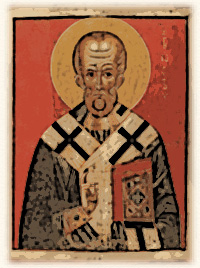
However, the original Nicholas is a shadowy figure making it difficult to reconcile the popularity of this man with the almost complete lack of verifiable detail about his life.
The absence of facts did nothing to stop the numerous myths (A traditional story or tale that has no proven factual basis) that sprung up about the man. Many, many miracles (one more extravagant than the next) and good deeds were attributed to him including saving sailors from storms, restoring life to murdered boys, providing dowries for poor unmarried girls and destroying several pagan temples.
The Cult of St. Nicholas
In fact,
"the cult of St. Nicholas was, before the Reformation, the most intensive of any nonbiblical saint in Christendom." [02]
"By the height of the Middle Ages, St. Nicholas was probably invoked in prayer more than any other figure except the Virgin Mary and Christ Himself.” [03]
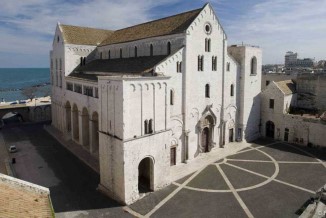 Nicholas was so widely revered that more than 2,000 churches were named for him, including three hundred in Belgium, thirty-four in Rome, twenty-three in the Netherlands and more than four hundred in England". Nicholas was so widely revered that more than 2,000 churches were named for him, including three hundred in Belgium, thirty-four in Rome, twenty-three in the Netherlands and more than four hundred in England".
Holland built no fewer than 23 churches dedicated to him, many of which are still standing. Amsterdam even adopted St. Nicholas as its patron saint as did a few other towns.
When Myra passed into the hands of the Saracens, the saint's relics were moved to a safer location in Bari Italy. The 6th century church (pictured) built there in the late 11th century overlooks the Adriatic Sea and is a popular tourist attraction. And his popularity continues even today (See article on Wikipedia).
However, it was his reputation for generosity that led to the most enduring of the legends. It was held, especially in Belgium and Holland (where he was known as Sinterklaas) that on December 5th - the eve of the Feast of Nicholas, the bishop himself would come from heaven and visit children in their homes, giving gifts to those who had been good. Nicholas, decked out in full ecclesiastical garb (bishop's vestments, with miter and crozier), would arrive on a flying gray or white horse, or even a white donkey, depending on the custom.
In Belgium
On St. Nicholas' Eve, December 5th, or the weekend before, children put their shoes or small baskets at the hearth or beside the door with carrots, turnips, and a sugar lump for the saint's horse and a glass of wine for the saint. There may also be a picture they've drawn (or a list) showing what they would like.
They believe St. Nicholas rides on horseback over the roof tops, dropping his gifts down the chimneys. In the morning shoes have been filled with chocolates, spiced cookies shaped like the saint and Piet, oranges, marzipan, and toys. In the spirit of St. Nicholas, treats are meant to be shared, not hoarded. Bad children, of which there are none, would find twigs. … [04]
And in Germany
In Roman Catholic areas of southern Germany, such as Bavaria, Sankt Nikolaus still comes as a with flowing beard and a bishop's and staff. Houses are thoroughly cleaned and children clean and polish their shoes or boots in preparation for the visit. On the evening before, children put letters to the good saint along with carrots or other food for his white horse or donkey on a plate or in their shoes.
These are left outside, under the bed, beside a radiator, or on a windowsill in hopes of finding goodies from St. Nicholas the next morning. During the night Sankt Nikolaus goes from house to house carrying a book in which all the children's deeds are written. If they have been good, he fills their plate, shoe or boot with delicious fruits, nuts and candies. If not, they may find potatoes, coal, or twigs. [05]
Santa Claus = St. Nicholas +?
There is absolutely nothing to connect the ancient Bishop to the celebration of Christmas on December 25th - not even in appearance.
Not only is the fast of Saint Nicholas observed on the 6th of December (the date of his death in AD 343) in Western Christian countries but in Catholic iconography he is depicted as a slim ascetic looking man dressed in religious apparel - a bishop wearing the insignia of this profession: a red bishop's cloak, red miter and a bishop's staff. He bears no physical resemblance to the modern day Santa Claus who has a long white beard and is usually short and fat. In fact, if the ancient bishop came face to face with the modern Santa Claus he would have no idea of who or what he was looking at.
In other words, the tradition of St. Nicholas is not synonymous with the role of Santa Claus. Although Santa Claus originally sprang from the St Nicholas' reputation for generosity, the legend drew heavily on other sources, rapidly morphing into the modern day version.
Santa Claus is, in fact, a blend of many different cultures, customs, early legends and mythological creatures. Consider, for example, the following.
Ancient And Diverse Origins - Odin and Thor
Many Santa researchers agree that some traits of Santa was borrowed from Norse or Scandinavian mythology.
Odin
Odin, also called Wodan, Woden, or Wotan, was one of the principal gods of Norse mythology. He was introduced to the British Isles with the arrival of the Vikings in the 9th and 10th centuries. He lived in Valhalla (the North) and was portrayed with a long white beard riding through the sky on an eight-legged, white horse name Sleipnir. He was said to be
spiritual, wise, and capricious. In centuries past, when the midwinter Yule celebration was in full swing, Odin was both a terrifying specter and an anxiously awaited gift-bringer, soaring through the skies on his flying eight-legged white horse, Sleipnir.
Back in the day of the Vikings, Yule was the time around the Winter Solstice on Dec. 21. Gods and ghosts went soaring above the rooftops on the Wild Ride, the dreaded Oskoreia. One of Odin’s many names was Jólnir (master of Yule). Astride Sleipnir, he led the flying Wild Hunt, accompanied by his sword-maiden Valkyries and a few other gods and assorted ghosts.
The motley gang would fly over the villages and countryside, terrifying any who happened to be out and about at night. But Odin would also deliver toys and candy. Children would fill their boots with straw for Sleipnir, and set them by the hearth. Odin would slip down chimneys and fire holes, leaving his gifts behind. [06]
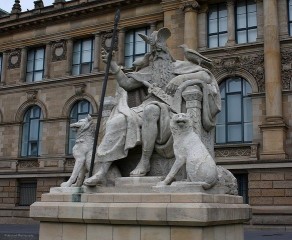 Prior to the Germanic peoples' Christianization, Germanic folklore contained stories about the god Odin (Wodan), who would at Yule each year have a great hunting party accompanied by his fellow gods and the fallen warriors residing in his realm. Children would place their boots, filled with carrots, straw or sugar, near the chimney for Odin's flying horse, Sleipnir, to eat. Odin would then reward those children for their kindness by replacing Sleipnir's food with gifts or candy [Siefker, chap. 9, esp. 171-173]. This practice survived in Germany, Belgium and the Netherlands after the adoption of Christianity and became associated with Saint Nicholas.[07] Prior to the Germanic peoples' Christianization, Germanic folklore contained stories about the god Odin (Wodan), who would at Yule each year have a great hunting party accompanied by his fellow gods and the fallen warriors residing in his realm. Children would place their boots, filled with carrots, straw or sugar, near the chimney for Odin's flying horse, Sleipnir, to eat. Odin would then reward those children for their kindness by replacing Sleipnir's food with gifts or candy [Siefker, chap. 9, esp. 171-173]. This practice survived in Germany, Belgium and the Netherlands after the adoption of Christianity and became associated with Saint Nicholas.[07]
The picture on the left is of an 1888 statue of Odin that stands in front of the State Museum of Lower Saxony, Hanover, Germany.
The Tjängvide image stone (on the right) dates back to the Viking Age. It was discovered in 1844 on the farm of  Tjängvide in Sweden and now housed in the Museum of National Antiquities in Stockholm. It is approximately 5.5 foot tall, and 4 foot high. The rider on his horse on the stone is Tjängvide in Sweden and now housed in the Museum of National Antiquities in Stockholm. It is approximately 5.5 foot tall, and 4 foot high. The rider on his horse on the stone is  usually identified with Odin on his eight-legged horse Sleipnir, usually identified with Odin on his eight-legged horse Sleipnir,
The eight legged horse may be the origins of the eight reindeer that we know of today. Santa originally had eight reindeer - the ninth (Rudolph) was the result of a verse written by Robert L. May for Montgomery Ward in 1939 and published as a book to be given to children in the store at Christmas.
Thor:
Additionally, a convincing case can be made for the link between Santa and Odin's son - the Germanic god Thor after whom Thursday (Thor's Day) is named. Ancient Norse mythology tells us that (Emphasis Added)
Thor was the god of the peasants and the common people. He was represented as an elderly man, jovial and friendly, of heavy build, with a long white beard. His element was the fire, his color red. The rumble and roar of thunder were said to be caused by the rolling of his chariot, for he alone among the gods never rode on horseback but drove in a chariot drawn by two white goats (called Cracker and Gnasher).
He was fighting the giants of ice and snow, and thus became the Yule-god. He was said to live in the "Northland" where he had his palace among icebergs. By our pagan fore-fathers he was considered as the cheerful and friendly god, never harming the humans but rather helping and protecting them. The fireplace in every home was especially sacred to him, and he was said to come down through the chimney into his element, the fire. [08]
One would be hard put to ignore the many characteristics the two have in common. Both are elderly, jovial and friendly and of heavy build sporting long white beards. Both wore red, and used chimneys (Odin's element was said to be fire). Both live in the North and arrive by chariots pulled by animals. Santa's reindeer are named Dasher, Dancer, Prancer, Vixen, Comet, Cupid, Donner and Blitzen, while Odin's two white goats were called Cracker and Gnasher.
Incidentally,Cupid is the god of desire, erotic love and attraction and affection in classical mythology. Donner is the southern Germanic form of the god of thunder, corresponding to Thor in Norse mythology.
Santa's Companion
A little-known detail about the legend of St. Nicholas has been all but erased from memory. According to folklore, he travels about with a variety of somewhat sinister companions. Although he had many names or aliases and his appearance and activities vary in a number of details, the sidekick’s presence was a well documented fact - he was always there.
Czechoslovakia
In the Czech Republic, Saint Nicholas or svatý Mikuláš is accompanied by the cert (Devil) and andel (Angel).
France:
In France, Saint Nicholas' companion is called "Rubbels" in German-speaking Lorraine and Hanstrapp (in Alsace, East of France) and the Père Fouettard (Wallonia, Northern and Eastern France).
 Holland: Holland:
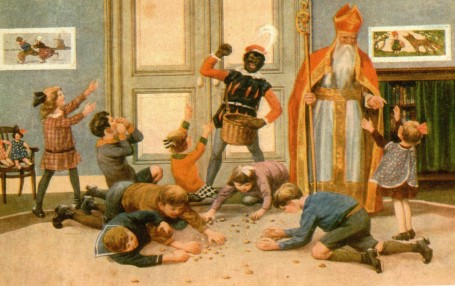
In Holland St. Nicholas is accompanied by Black Peter (Zwarte Piet). According to the Encyclopedia of Christmas and New Year's Celebrations.
Children in the Netherlands receive presents on St. Nicholas's Day, December 6. According to old Dutch folk beliefs, each year St. Nicholas and his helper, Zwarte Piet, or Black Peter, sail from Spain to Holland in a ship loaded with presents for good children.
Nowadays, Black Peter not only carries St. Nicholas's sack of presents, but also brandishes a birch rod which he uses to discipline undeserving children. Truly troublesome youngsters face sterner punishment. Black Peter tosses them into his sack and carries them back to Spain with him.
Black Peter traditionally appears as a dark-skinned man dressed in the costume of a sixteenth-century Spaniard as shown in the picture above. Perhaps this image of Black Peter developed during the sixteenth century, when the Dutch suffered under Spanish rule. The Dutch may have associated Spain with dark-skinned people since a north African ethnic group known as the Moors ruled parts of Spain from the eighth to the fifteenth centuries. ... the most likely explanation for Peter's dark skin comes from old folk beliefs. Medieval Europeans often imagined 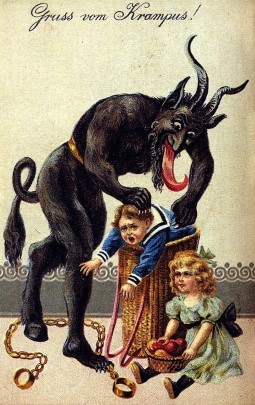 the devil as black-skinned. [09] the devil as black-skinned. [09]
In parts of central Europe like Austria, Germany, and Switzerland, the character of Black Peter was a more like a monster, with horns, long hair, and a red tongue (right). He was known by a variety of names including Klaubauf, Krampus, Grampus, Bartel. St. Nicholas sent naughty children to him to be beaten. [10] In fact, In Austria and parts of Germany, December 5 is called Krampusnacht, emphasizing the demonic companion.
Germany
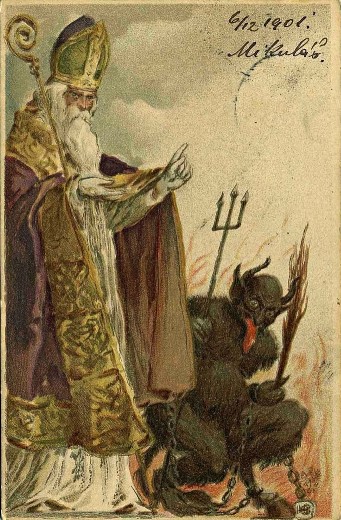 seems to have had more than their fair share of St. Nicholas alter egos. seems to have had more than their fair share of St. Nicholas alter egos.
Krampus (krampen means claw) a terrifying horned, goat-like creatures functioned as a counterpart to kindly St. Nicholas, who rewards children with sweets. Krampus, in contrast, would swat "wicked" children, stuff them in a sack, and take them away to his lair.
See Footnote: The Horrifyingly Evil Modern Day Krampus in America and Around The World
Knecht Ruprecht was Saint Nicholas' most familiar attendant in Germany and can be traced as far back as the 17th century. He startles onlookers with his menacing demeanor and unkempt appearance. He wears clothing made of rags, straw, or furs, and often adds a soot-blackened face, beard, or a frightening mask. In past times he sometimes sported devil's horns. In addition, he carries one or more of the tools of his trade: a whip, stick, bell, or sack containing treats for well-behaved children. The bell warns of his approach.
Pelz Nichol (Belsnickel) translated means "Nicholas dressed in fur". This legend originated in from a region in southwestern Germany. He carries a switch with which to beat naughty children, but also pockets full of cakes, candies, and nuts for good children. Pelz Nichols were originally to be propitiated with offerings to ensure bounteous harvest and full flocks and herds during the coming year.
The Long Leap - The Development of Santa Claus in America
It has been oft claimed that Santa Claus was introduced to America by the Dutch who settled in what was known as New Amsterdam - now New York. Apparently this story is without much if any merit. The settlers of New Amsterdam were Protestants not Catholics with little St. Nicholas tradition. [11] However, the name Santa Claus is derived from the Dutch "Sinterklaas".
Historian Charles W. Jones' research into early colonial New York newspapers, books, diaries and letters turned up no mention at all of St. Nicholas until the time of the Revolution" [12]
1804 - Washington Irving (best remembered for giving the world "The Legend of Sleepy Hollow"
After the American Revolution, New Yorkers remembered with pride their colony's nearly forgotten Dutch roots. John Pintard, the influential patriot and antiquarian who founded the New York Historical Society in 1804, promoted St. Nicholas as patron saint of both society and city. In January 1809, Washington Irving joined the society and on St. Nicholas Day that same year, he published the satirical fiction, Knickerbocker’s History of New York, with numerous references to a jolly St. Nicholas character. This was not the saintly bishop, rather an elfin Dutch burgher with a clay pipe. [13] Note: The clay pipe was possibly a holdover from the Dutch Sinter Klaas.
Irving revised his History of New York in 1812 adding details about Nicholas'. In Knickerbocker's History of New York he was first described as rattling down the chimney to "bring his yearly presents to children."
And the sage Oloffe dreamed a dream and lo, the good St. Nicholas came riding over the tops of the trees, in that self same wagon wherein he brings his yearly presents to the children. . . And when St. Nicholas had smoked his pipe, he twisted it in his hat band, and laying his finger beside his nose, gave the astonished Van Kortlandt a very significant look; then, mounting his wagon, he returned over the treetops and disappeared... At this early period was instituted that pious ceremony, still religiously observed in all our ancient families of the right breed, of hanging up a stocking in the chimney on St. Nicholas Eve; which stocking is always found in the morning miraculously filled; for the good St. Nicholas has ever been a great giver of gifts, particularly to children. [14]
1821 - William Gilley: in 1821, a New York printer named William Gilley published a poem about a Santeclaus who dressed all in fur and drove a sleigh pulled by one reindeer.
1822 - Clement Clarke Moore: In 1822, Clement Clarke Moore (son of the Reverend Benjamin Moore) professor of Oriental and Greek literature at the General Theological Seminary (1821–50) in New York City, claimed to be the author of A Visit from St. Nicholas more commonly known today by its opening line, "'It was the night before Christmas. It was first published anonymously in the Troy (New York) Sentinel on December 23, 1823. Moore took credit for the work in 1844 after it appeared in his collection Poems, and he claimed that he had written it to amuse his children for Christmas in 1822 and that, unknown to him, it had been copied and given to the Sentinel. [15]
Moore obviously drew on Irving's description but added some elements of the Norse legends. For example not only did he give St. Nick eight reindeer and named all of them, but at least two of the names were based on Thor's chariot drawn by the two white goats (Cracker and Gnasher)
1863 - Thomas Nast: Thomas Nast was a hard-bitten editorial cartoonist who turned out drawings every week for the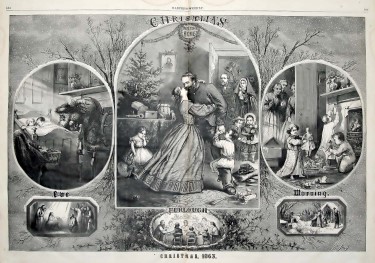 nation's newspapers. He supported Lincoln during the Civil War, campaigned against Boss Tweed's corrupt control of New York City's government, and protested against the lynching of black men and women in the South. He also reinforced ethnic stereotypes of Irish as subhuman brutes, and invented the symbols of the donkey and the elephant, respectively, for both the Democratic and Republican parties. [16] nation's newspapers. He supported Lincoln during the Civil War, campaigned against Boss Tweed's corrupt control of New York City's government, and protested against the lynching of black men and women in the South. He also reinforced ethnic stereotypes of Irish as subhuman brutes, and invented the symbols of the donkey and the elephant, respectively, for both the Democratic and Republican parties. [16]
Nast joined the staff of Harper's Weekly in 1862 during the Civil War and over the next two decades contributed 33 Christmas drawings to Harper's Weekly - Santa seen or referenced in all but one.
His first Santa (in the postdated January 3, 1863 issue) showed Santa dressed in stars and stripes distributing Christmas presents to Union soldiers in camp. One of his earliest illustrations from Harper's Weekly, December 26, 1863 (pictured above left) depicted a Union soldier returning home on holiday furlough surrounded by his family and Yuletide images of Santa Claus, stockings, and Christmas dinner. surrounded by his family a
It wasn't long before corporations realized Santa's marketing value, thus he began his career in commercial advertising endorsing everything from White Rock mineral water, whiskey, GE light bulbs, cigarettes, Florida orange juice, beer, and women's lingerie. In the 1930s The Coca Cola Company commissioned artist Haddon Sundblom to recreate him into a jollier version of his previous selves.
But here is where it gets really interesting.
The Model For Nast's Santa?
In order to understand Nast's earliest depictions of Santa Claus we have to travel back in time to his boyhood. The Dutch Sinterklaas was traditionally depicted as a tall Catholic bishop. However,
Thomas Nast was born in 1840 in what is now Germany. At the time, his birthplace of Landau was part of the Kingdom of Bavaria. His father served as a musician in the kingdom's army. As a little boy there, Thomas was visited by Pelze-Nicol, the German Santa Claus, who brought treats and toys, or punishment for the naughty children. The Pelz-Nicol (Also called Pelznickel or Belsnickel) of his childhood would find his way into American imagery. [17]
In other words, Thomas Nast drew Santa to resemble the figure he had known in Bavaria when he was a child. (Germans who immigrated to America brought the tradition of Pelz-Nicol with them.)
"For Christmas of 1866, with the war ended, Nast removed Santa from current events and created a two-page spread for Harper's Weekly that filled in the blanks about Santa's life. Entitled Santa Claus and His Works, the center scene carried the familiar image of the elf filling stockings hung by the fire with care. Other scenes incorporated the German folklore Nast had imbibed as a child and added new elements." [18]
Santa researcher, Phyllis Siefker, wrote the following.
It seems obvious, therefore, that Santa Claus can be neither the alter ego of Saint Nicholas nor the brainchild of Washington Irving. . . If we peek behind the imposing Saint Nicholas, we see, glowering in the shadows, the saint's reprobate companion, Black Pete. He, like Santa, has a coat of hair, a disheveled beard, a bag, and ashes on his face. . . In fact, it is this creature, rather than Irving's creation or an Asian saint, who fathered Santa Claus. [19]
Note: Santa Claus, Last of the Wild Men: The Origins and Evolution of Saint Nicholas, authored by the late University of Kansas associate, Phyllis Siefker is no child's book, but a scholarly exploration into the origin of Santa Claus. It is published by the prestigious McFarland Publishers, a leading publisher of reference and academic books. This book carries no Christian bias, but is simply a secular, non Christian scholastic study.
Nash continued to expand on his original Santa
From 1866-1871, Nast continued to elaborate upon the image of Santa Claus portrayed in "Santa and His Works." As in the featured cartoon, he also emphasized during this period Santa's disciplinary role in judging whether the behavior of children during the past year warranted Christmas rewards or punishment.
In an 1870 cartoon, Santa surprises two naughty children by jumping out as a jack-in-the-box clutching a switch for spanking. In 1871, Santa sits at his desk reading letter from parents chronicling their children's good and bad acts, with the "letters from naughty children's parents" far outnumbering the "letters from good children's parents." [20].
Santa Claus - Also Known As...
Kriss Kringle?
The seemingly innocent, friendly, name Kriss Kringle is an alteration of German dialectal Christkindl which is German for "Christ Child".
According to legend, Martin Luther is credited with introducing the Christkindl to Germany and parts of Switzerland. He apparently thought the growing popularity of Saint Nicholas took away from the true meaning of Christmas, which was to celebrate the birth of Jesus - therefore promoted Christ as the children's gift-give, hoping to draw attention to the child for whom Christmas is named. However the Lutheran Christkindl (Christ Child) was not a babe in swaddling; it was a teen-aged girl in a flowing white gown, gold crown and a candle.
Also See Martin Luther -
Not many Martin Luther devotees seem to be unaware that he taught that being baptized and partaking of the sacraments are necessary for salvation. In other words several Catholic doctrines remained firmly entrenched in his belief system.
And that is not all. All too many Christians tend to gloss over the fact that Luther slandered everyone he disagreed with. He made strident and offensive verbal attacks against both the papacy and the Anabaptists, while his violent polemics against the Jews are appalling examples of extreme anti-Semitism.
During the 18th Century, German and Swiss immigrants, settling in Pennsylvania, brought the tradition of the Christkindl with them. However, somewhere along the line in the United States, Kris Kringle morphed from being the Christ Child to a name for Santa Claus. 'Christkindl' Markets found everywhere from Nuremberg to Chicago, Ohio and Texas with Frederick, Maryland boasting a Kris Kringle Procession. Santa Claus is always the main feature.
St. Nick
The name Old Nick came from Saint Nicholas, the bishop of Myra however, I find it interesting that it is also a name for the devil .
Merriam-Webster: used as a name of the devil
Collins English Dictionary: informal a jocular name for Satan
American Heritage Dictionary: The Devil; Satan.
An Anagram?
Much has been said about 'Santa' being an anagram for 'Satan'. While I am not sure how much importance to attach to this, the fact that Sanat Kumara is obviously an anagram for Satan gives me pause for thought. According to some of the teachings derived from modern Theosophy, i.e. the teachings of Alice A. Bailey, C. W. Leadbeater, Guy Ballard, Elizabeth Clare Prophet and Geraldine Innocente, Sanat Kumara is the Lord or Regent of Earth and of humanity.
It is believed by some that he is the founder of the Great White Brotherhood, and that he lives in a city on the etheric plane called Shamballa located above the Gobi Desert in Mongolia.
Read More About Alice Bailey and The Reappearance of 'The Christ'
Do Origins Matter?
As said earlier, Santa Claus is a amalgam of many different cultures, customs, old Norse myths, early legends and mythological creatures. However, over the years, he morphed (a little added here and a little changed there) into the modern day, well known and well recognized figure.
The question is whether or not it matters.
After all many of our traditions are rooted in pagan festivities and customs. For example, the custom of decorating a Christmas Tree originated in Germany arriving on American shores in the ‘40's. Time Magazine reported..
"even before the arrival of Christianity, Germans decorated evergreen trees to brighten the dark, gloomy days of the winter solstice. The first "Christmas trees" appeared in Strasbourg in the 17th century and spread to Pennsylvania in the 1820s with the arrival of German immigrants. When Queen Victoria married Germany's Prince Albert in 1840, he brought the tradition to England. Eight years later, the first American newspaper ran a picture of the royal Christmas tree and Americans outside of Pennsylvania quickly followed suit." [21]
However, Santa is not quite as innocuous as a tree that, in spite of the ancient traditions associated with it, is still just a tree..
The modern Santa transformed from what was clearly mythology into the modern day, well known and well recognized and, may I add, much loved figure that bears far too many similarities to the one who is known in the Bible as a great deceiver. (See Revelation 12:9 and 20:3)
Santa Vs. The Bible
A Carpenter
The Bible
"Is not this the carpenter, the son of Mary, and brother of James and Joses and Judas and Simon? (Mark 6:3 NASB)
Santa Claus:
Santa is a carpenter.
A White Horse!
The Bible:
And I saw heaven opened, and behold, a white horse, and He who sat on it is called Faithful and True, and in 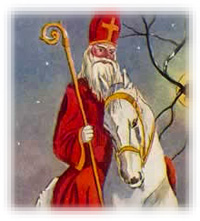 righteousness He judges and wages war. (Revelation 19:11 NASB) righteousness He judges and wages war. (Revelation 19:11 NASB)
However, in Revelation 6, the Antichrist also appears on a white horse.
I looked, and behold, a white horse, and he who sat on it had a bow; and a crown was given to him, and he went out conquering and to conquer. (Revelation 6:2 NASB)
See A Comparison of The Seals And Matthew 24:4-9 On THIS Page
Santa Claus:
Most people are not aware that until the nineteenth century, Santa flew through the sky, visiting housetop to housetop, not in a sled drawn by reindeers — but on a white horse.
"In his Dutch form of Sinterklaas he was imagined to carry a staff, ride above the rooftops (on a huge white horse) and have mischievous helpers who listened at chimneys to find out whether children were being bad or good." [22]
Remember Odin was also portrayed as riding through the sky on an eight-legged, white horse name Sleipnir which is quite possibly where the idea for the original eight reindeer may have come from. The ninth was added later.
Santa is Virtually Omniscient (All-knowing).
The Bible:
The eyes of the Lord are in every place, Watching the evil and the good. (Proverbs 15:3 NASB)
For the eyes of the Lord move to and fro throughout the earth that He may strongly support those whose heart is completely His. ... (2 Chronicles 16:9 NASB)
"So do not be like them; for your Father knows what you need before you ask Him. (Matthew 6:8 NASB)
Santa Claus:
Children are taught that Santa knows things that only God Almighty can know.
He sees you when you're sleeping, He knows when you're awake
He knows if you've been bad or good So be good for goodness sake
Santa Claus is coming to town
Santa is Virtually Omnipotent (All-powerful).
The Bible:
"Is anything too difficult for the Lord? (Genesis 18:14 NASB)
Santa Claus:
Children are taught that no feat is too great for their Santa. No storm is big enough to stop his amazing ability to deliver gifts around the world in a twinkling of an eye. He defies the laws of nature and comes down the most narrow (and hottest) of chimneys. Lets not forget the millions upon millions of gifts produced in his ‘workshop' and delivered each to the correct child.
To the average child - Santa can do anything. Apart from requests for this doll or that train, Santa also gets some heartbreaking appeals for the restored health of a parent or sibling, the saving of a parents marriage, for peace in the house. Nothing seems to be too hard for Santa
Santa is Virtually Omnipresent (Present Everywhere)
The Bible:
Where can I go from Your Spirit? Or where can I flee from Your presence? If I ascend to heaven, You are there; If I make my bed in Sheol, behold, You are there. If I take the wings of the dawn, If I dwell in the remotest part of the sea, Even there Your hand will lead me, And Your right hand will lay hold of me. (Psalms 139:7-10 NASB)
Santa Claus:
Santa is Everywhere. To visit so many homes all over the world in one evening, requires nothing less than omnipresence. Prior to Christmas, Santa also appears at hundreds of street corners and shopping centers at the same time.
Santa Judges Children and Holds Them Accountable
The Bible:
So then every one of us shall give account of himself to God. Romans 14:12
And I saw the dead, small and great, stand before God; and the books were opened: and another book was opened, which is the book of life: and the dead were judged out of those things which were written in the books, according to their works. Revelation 20:12
Santa Claus:
But the children are accountable to Santa
He's making a list, He's checking it twice
He's gonna find out Who's naughty or nice.
Santa Can Give You Anything. . Just Ask.
The Bible:
Delight yourself in the Lord; And He will give you the desires of your heart. (Psalms 37:4 NASB)
If ye then, being evil, know how to give good gifts unto your children, how much more shall your Father which is in heaven give good things to them that ask him? [Matthew 7:11]Delight yourself in the Lord; And He will give you the desires of your heart. (Psalms 37:4 NASB)
"Ask, and it will be given to you; seek, and you will find; knock, and it will be opened to you. "For everyone who asks receives, and he who seeks finds, and to him who knocks it will be opened. (Matthew 7:7-8 NASB)
Santa Claus:
Each Christmas the U.S. Postal Service receives millions of letters addressed to "Santa Claus" In the weeks before Christmas millions of children around the globe with either/or write to Santa or visit him 'in person' with a list of their dearest desires. They will climb in to his lap and whisper and disclose the yearnings of their hearts. And come Christmas morning they will jump out of bed with gleeful anticipation to see what Santa has brought them.
[On the other hand A child may receive little or nothing from Santa because his/her parents are poor. Unfortunately, the child has probably already learned that bad children get nothing from Santa and come to the conclusion that he/she is ‘bad'].
Bring The Little Children Unto Me
The Bible:
And they brought young children to him, that he should touch them: and his disciples rebuked those that brought them. But when Jesus saw it, he was much displeased, and said unto them, Suffer the little children to come unto me, and forbid them not: for of such is the kingdom of God. (Mark 10:13-14).
Santa Claus:
Oh, how he loves the little children.
All the children of the world.
Red and yellow, black and white,
They are precious in his site.
Santa loves the little children of the world.
Santa's 'Throne'
The Bible:
And he said, Hear thou therefore the word of the Lord: I saw the Lord sitting on his throne, and all the host of heaven standing by him on his right hand and on his left. [1 Kings 22:19]
11 And I saw a great white throne, and him that sat on it, from whose face the earth and the heaven fled away; and there was found no place for them. And I saw the dead, small and great, stand before God; and the books were opened: and another book was opened, which is the book of life: and the dead were judged out of those things which were written in the books, according to their works. Revelation 20:11-12
Santa Claus
Almost every local mall in the US has a Santa sitting on his 'throne' with the children lined up to sit on his lap and be asked the question "Have you been a good little boy (or girl)?"
Believe In Santa
The Bible:
And they said, Believe in the Lord Jesus, and you will be saved... Acts 16:31
The heart of the Christian faith is "believing" in the Lord Jesus Christ. Salvation is believing In Jesus Christ.
Santa Claus:
Yet, Many many more children will be asked at Christmas whether they believe in Santa than will be asked if they believe in Jesus. Santa will be preached hundreds of times more than Jesus… with parents as the chief evangelicals. "Little Boy, Little Girl, DO You Believe In Santa?"
If the Christian world had even a small drop of the faith that the average child
has in Santa – we'd have revival overnight!
Conclusion
In 1994, the magazine The Onion featured an article entitled "Ho! Ho! Ho! I Am God" - ostensibly written by Santa Claus. a parody that was accurate in many ways.
"I love visiting each and every one of your homes, stuffing your stockings with toys, and enjoying the milk and cookies you leave for me. But mostly I love Christmas because it's the celebration of the birth of my son, Jesus the Christ. You see, I'm God. . . Don't I look familiar? I'm old, I have a white beard, I love everyone. I'm the same God as the one you and your mommy and daddy worship on Sundays. . .
Okay, I admit it. I'm not God. But I'm better than God. I'm jollier, and I give you real toys, not boring old psalms and empty promises you can only collect on when you die. Worship me, not Him! Worship Santa! I am God!" [23]
Paul was very concerned about the false doctrines that had already raised their ugly heads in the early church and, were he alive today, I have little doubt that he would be scratching his head wondering where to start. (See, for example Doctrines of Demons).
But as serious as they are are, false doctrines are not the only problem. Can anyone possible believe that were they familiar with how we celebrate Christmas, Paul or any of the early apostles would encourage children to hang stockings from their mantels for Santa to fill on Christmas Eve?
For the time will come when they will not endure sound doctrine; but wanting to have their ears tickled, they will accumulate for themselves teachers in accordance to their own desires, and will turn away their ears from the truth and will turn aside to myths. (2 Timothy 4:3-4 NASB)
But have nothing to do with worldly fables fit only for old women. On the other hand, discipline yourself for the purpose of godliness; (1 Timothy 4:7 NASB)
As I urged you upon my departure for Macedonia, remain on at Ephesus so that you may instruct certain men not to teach strange doctrines, nor to pay attention to myths and endless genealogies, which give rise to mere speculation rather than furthering the administration of God which is by faith. (1 Timothy 1:3-4 NASB)
This Christmas Eve millions and millions of little children will climb into their beds "looking for their blessed hope and the glorious appearing" of Santa Claus. There may not be a single Christian on earth who looks forward to or longs for the return of the Lord Jesus Christ and the coming of God’s kingdom as much as the average child longs for Santa! (Also See What and Where is Heaven?)
How did we let this happen? How did we let a pagan legend grow to the point it overtook and overshadowed Jesus? In fact, we have opened our homes to a thief, and have stood by and offered no resistance while he stole the heart of childhood. Worse, we have taught our children to put another god before Christ.
So this Christmas, we should try to captivate our children's imagination with the story of Christ born in a manger" and the account of the brilliant guiding star that led the Magi and their gifts to the new born King. Let us inspire our children to give gifts to Him and in His name. Let us make Christmas "holy ground" in our homes this year".
Footnote I - The Modern Krampus
There is no question that Santa Claus has pretty much usurped the place of Christ in Christmas. However, the modern generation's penchant for the supernatural, the horrific, and the gory has led to the popularization of the ancient Krampus - originally an ancient demon, sometimes described as being half goat, who was assimilated into the St. Nicholas myth.
Krampus, whose name is derived from the German word krampen, which means claw, is said to be the son of Hel, who rules the realm of the dead in Norse mythology. Krampus also shares characteristics with demonic creatures in Greek mythology, including satyrs and fauns. [24]
See The Chronicles of Narnia
Sadly in The Chronicles of Narnia C. S. Lewis introduced a wide spectrum of mythological creatures including satyrs that inhabited Narnia. Worse, the Greek god Bacchus, the Maenads and Mr. Tumnus (a Pan like figure) were portrayed in a positive light peacefully co-existing with Aslan (The figure of Christ).
Like the Tooth Fairy the Krampus' of medieval Europe were known only by oral tradition. They had a definitive function but no definitive form. When people began dressing up as Krampus they must have used whatever materials they had on hand - fur, goat's horns, straw etc.
The sensibilities of the modern world are however, dulled by surfeit. True to form, many westerners (Americans include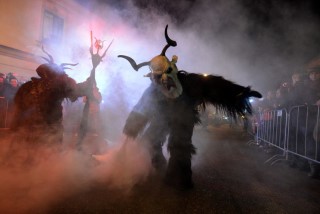 d) completely desensitized by Halloween, Harry Potter, and an endless round of 'entertainment' featuring zombies, axe killers, vampires, witches etc. have wholeheartedly embraced the darker side of the St. Nicholas legends. d) completely desensitized by Halloween, Harry Potter, and an endless round of 'entertainment' featuring zombies, axe killers, vampires, witches etc. have wholeheartedly embraced the darker side of the St. Nicholas legends.
The Krampus today is indeed a horrifyingly evil figure. For example, see Krampuses on parade in the Czech Republic (right). Source - Huffington Post [25].
Krampus parties and parades are even happening all across the United States every year each one featuring one Krampus 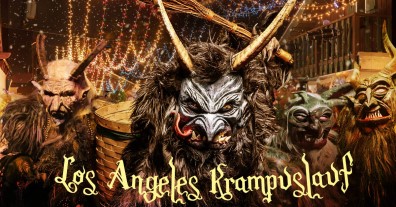 more hellish than the next. Here are just a few of them. more hellish than the next. Here are just a few of them.
Washington DC (https://krampusnachtdc.com)
Bloomington, Indiana (http://www.cultofweird.com/blog/bloomington-krampus-night/)
Los Angeles (http://krampuslosangeles.com/photos-krampusfest-past -events/) (left) -events/) (left)
New Orleans (https://kreweofkrampus.com)
Cleveland, Ohio (https://www.facebook.com/Krampusofcleveland)
Columbus Ohio (https://www.instagram.com/p/Cze3kD_Lwt4/)
Seattle (https://krampusseattle.com)
As the old saying goes -'Fools Rush In Where Angels Fear To Tread'
{PLACE IN TEXT}
End Notes
[01] Nicholas of Myra https://www.livius.org/articles/person/nicholas-of-myra/
[02] Charles. W. Jones. "Knickerbocker Santa Claus." St. Nicholas Center.
https://www.stnicholascenter.org/who-is-st-nicholas/origin-of-santa/knickerbocker
[03] Del Re, Gerard and Patricia. The Christmas Almanack. New York: Random House, 2004, p.131
[04] St. Nicholas Center. Around The World. http://www.stnicholascenter.org/Brix?pageID=76. Lik=nk is no longer active
[05] St. Nicholas Center. Germany. https://www.stnicholascenter.org/around-the-world/customs/germany
[06] Don't take Odin out of Yule. https://www.norwegianamerican.com/dont-take-odin-out-of-yule/
[07] NationMaster. Encyclopedia > Santa Claus http://www.statemaster.com/encyclopedia/Santa-Claus
[08] Francis X. Weiser, Handbook of Christian Feasts and Customs. (New York: Harcourt, Brace and World, Inc., 1958]
https://archive.org/stream/WeiserChristianFeastsandCustoms/Weiser--ChristianFeastsandCustoms_djvu.txt
[09] Black Peter. Encyclopedia of Christmas and New Year's Celebrations, 2nd ed. © Omnigraphics, Inc. 2003 and quited by The Free Dictionary. https://encyclopedia2.thefreedictionary.com/Black+Peter
[10] Jeff Westover. The Story of Black Peter. https://mymerrychristmas.com/the-story-of-black-peter/
[11] B. K. Swartz, Jr. The Origin Of American Christmas Myth And Customs.
http://www.arthuriana.co.uk/xmas/swartz/American%20Christmas%20Origins.htm
[12] Santa Claus was Made by Washington Irving.
https://historicaldigression.com/2014/12/06/santa-claus-was-made-by-washington-irving/
[13] St. Nicholas Center. Saint Nicholas and the Origin of Santa Claus. http://www.stnicholascenter.org/Brix?pageID=35
[14] Irving, Washington. Knickerbocker’s History of New York, Publisher: CreateSpace Independent Publishing Platform (September 26, 2016) p. 115. Also https://www.gutenberg.org/files/13042/13042-h/13042-h.htm
[15] Clement Clarke Moore. https://www.britannica.com/biography/Clement-Clarke-Moore
[16] Thomas Nast: The Father of Modern Political Cartoons by Fiona Deans Halloran published by The University of North Carolina Press (2012)
[17] Thomas Nast: His Period And His Pictures by Albert Bigelow Paine published by New York: The MacMillan Company (1904) p. 6
[18] Patrick Young. How German Refugee Thomas Nast Invented How Santa Claus Looks Today Back During the Civil War and Reconstruction. December 20, 201. https://thereconstructionera.com/how-german-refugee-thomas-nast-invented-how-santa-claus-looks-back-during-the-civil-war-and-reconstruction/
[19] Siefker, Phyllis. Santa Claus, Last of the Wild Men: The Origins and Evolution of Saint Nicholas. Jefferson: McFarland & Company, Inc., 1997, p. 15
[20] Robert C. Kennedy. Santa Claus and His Works.
http://www.harpweek.com/09Cartoon/BrowseByDateCartoon.asp?Month=December&Date=25
[21] O Tannenbaum!
http://content.time.com/time/specials/packages/article/0,28804,1868506_1868508_1868530,00.html
[22] A Pictorial History of Santa Claus . https://publicdomainreview.org/collection/a-pictorial-history-of-santa-claus
[23] Santa Claus, "Ho! Ho! Ho! I Am God!" The Onion, 29 Nov. - 5 Dec., 1994, https://www.theonion.com/ho-ho-ho-i-am-god-1819583286
[24] Tanya Basu and Becky. Little, National Geographic. Krampus the Christmas Devil Is Coming to More Towns. So Where's He From?
https://www.nationalgeographic.com/news/2014/12/141222-krampus-christmas-devil-demon-krampusnacht/
[25] https://www.huffpost.com/entry/krampus-festivals_n_566fb5d1e4b0e292150f12e9. The article is entitled The Krampus Parade Will Give You The Christmas Of Your Nightmares..
|