|
ON THIS PAGE
Emphasis Mine In Bible Verses
Introduction
The Why - The Reason For Baptism
Why Jesus Was Baptized
Why We Are Baptized
Is Baptism a Prerequisite Requirement For Salvation?
* We Are Asking The Wrong Question
The How - The Case For Immersion Vs. Other Methods
The Greek words Baptizo and Bapto
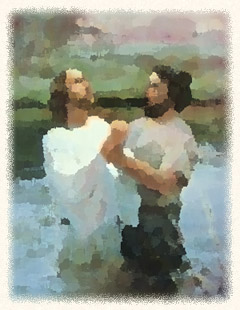
Jesus's Baptism - The How
Dip and Dye
Proof Texts Proffered To Show Baptism
Was Performed By Methods Other Than Immersion
None hold water
When Immersion is Not Possible
Introduction
The Greek word baptizo, baptizma etc. were was not translated into English but transliterated, i.e. they were simply written in the English alphabet thus creating new English words... baptize, baptism etc. used both for baptism in water and the baptism of the Holy Spirit.
Although some of the things of God are beyond our complete understanding, everything that pertains to our salvation (a life and death issue for every human being alive) is simple and straightforward. The Father decreed that death is the penalty of sin which means every last one of us is doomed. However, in His infinite mercy He sent His Son to earth not only to announce His coming kingdom but by dying in our place save those of who would put their trust in Him and be obedient to His commands. For Details See Salvation and Jesus's primary message - No! It wasn’t love as so many think)
Yet, man has managed to complicate virtually every aspect of the Gospel pontificating on and writing tomes about matters that Scripture is either very clear or says absolutely nothing, about. Much of the message has been cloaked in incomprehensible jargon and abstruse mystery understood by only a few. Take for example the Vatican's opening statements on the fate of infants who die without being baptized. Footnote I
One would imagine that the simple act of dipping another human being in water would escape the controversies that accompany far more complicated topics in Scripture. Not the case. Baptism is and always has been a subject of much disagreement. At times, the dispute stirred emotions to such a fever pitch that those who believed a different way were branded as heretics.
As an example of how far this went, John Calvin had a hand in Michael Servetus being burnt at the stake because he had the guts to point out the flaws (there were many besides infant baptism) in Calvin's theology. Although Luther never had anyone killed, he made strident and offensive verbal attacks against the papacy and the Anabaptists whom he considered enemies of the faith. About the latter he said they were "not men possessed by demons, but demons themselves possessed by worse demons." If that wasn't bad enough, his vitriolic abuse of the Jews are appalling examples of extreme anti-Semitism. As far as the very Catholic in his beliefs Augustine is concerned - well! read the article.
Calvinism
Martin Luther
The Sins of Augustine
Back To The Bible
When it comes to any and all matters pertaining to the faith we need to remember that the Bible and only the Bible is the sole arbitrator of both our beliefs and practice. Regardless of who they may be someone else's thoughts or beliefs is their opinion, not infallible doctrine.
The questions we need answered from Scripture are,
Why: what does baptism symbolize? is it a requirement for salvation?
How: Under normal circumstances are any of the various modes of baptism acceptable and does it matter?
When: Various denominations have their own thoughts and practices that their members adhere to. Some baptize infants or very young children putting forth various reasons for the practice. For example, a) the water sprinkled on infants brings salvation, b) they can have faith at that age, c) the faith of the parents speaks for the child who is too young to have explicit faith of his/her own. See Part II on the next page.
The first question is why we need to baptized, but because Jesus Himself was baptized perhaps we should begin with Him. In fact why Jesus had to be baptized at all understandably puzzles many people.
The Why - The Reason For Baptism
Why Jesus Was Baptized
Jesus as Our Eternal and Ultimate High Priest
We have to remember that Jesus had a double role. He was the ultimate sacrifice for our sins - the Lamb of God who bore the sins of many and at the same time the High Priest who offered the sacrifice.
In the Old Testament the consecration of priests involved several formalities before they could begin their duties one of the primary functions of which was to offer the ordained animal sacrifices for the sins of the people. Apart from the presentation of various items Aaron and his sons had to be washed in water. (Exodus 29:1-4).
"Now this is what you shall do to them to consecrate them to minister as priests to Me: take one young bull and two rams without blemish, and unleavened bread and unleavened cakes mixed with oil, and unleavened wafers spread with oil; you shall make them of fine wheat flour. "You shall put them in one basket, and present them in the basket along with the bull and the two rams. "Then you shall bring Aaron and his sons to the doorway of the tent of meeting and wash them with water. (Exodus 29:1-4 NASB)
Similarly as our High Priest Jesus was ritually consecrated with water before He embarked on His mission.
After being baptized, Jesus came up immediately from the water; and behold, the heavens were opened, and he saw the Spirit of God descending as a dove and lighting on Him, and behold, a voice out of the heavens said, "This is My beloved Son, in whom I am well-pleased." (Matthew 3:16-17 NASB)
After which John could legitimately testify that Jesus was the "Son of God"
"I myself have seen, and have testified that this is the Son of God." Again the next day John was standing with two of his disciples, and he looked at Jesus as He walked, and *said, "Behold, the Lamb of God!" (John 1:34-36 NASB)
Why We Are Baptized
The short answer is because Jesus commanded it.
John 4:2 states that Jesus Himself didn't baptize people although His disciples did. And, quite evidently, He intended the practice to continue. Sometime between His resurrection and ascension Jesus gathered his disciples together and gave them instructions that have since come to be known as the Great Commission...
And Jesus came up and spoke to them, saying, "All authority has been given to Me in heaven and on earth. "Go therefore and make disciples of all the nations, baptizing them in the name of the Father and the Son and the Holy Spirit, teaching them to observe all that I commanded you; and lo, I am with you always, even to the end of the age." (Matthew 28:18-20 NASB)
These instructions were closely followed by the apostles - the book of Acts recording numerous baptisms including the 3,000 odd people in Jerusalem who were baptized on Pentecost. (Acts 2:41).
The Significance
There is an extremely strong connection between baptism and the Israelites passing through the Red Sea. Because water baptism as we know it was unknown in Moses' time Paul was obviously using baptizo in its figurative sense when he spoke about Moses and the Israelites
For I do not want you to be unaware, brethren, that our fathers were all under the cloud and all passed through the sea; and all were baptized (Gr. baptizo) into Moses in the cloud and in the sea; and all ate the same spiritual food; and all drank the same spiritual drink, for they were drinking from a spiritual rock which followed them; and the rock was Christ. (1 Corinthians 10:1-4 NASB)
Going through the waters of the Red Sea identified the Israelites with Moses mediator of the Old Covenant, leader, and guide to Canaan - the Promised Land. Similarly, by passing through water Christians identify themselves with Jesus Christ, our leader, mediator of the New Covenant, and our only hope for getting to the Promised Land.
It should be noted that the 'baptism' of the Israelites took place after they came out of slavery in Egypt and began to follow Moses to Canaan. Similarly our baptism should take places after we come out of the bondage of Egypt and, with Christ in the lead, set our faces towards the Promised Land. See What and Where Is Heaven? It implies turning to Christ and away from the old life, consecrating oneself - body and soul - to God.
Or do you not know that all of us who have been baptized (Gr. baptizo) into Christ Jesus have been baptized (Gr. baptizo) into His death? Therefore we have been buried with Him through baptism (Gr. baptizma) into death, so that as Christ was raised from the dead through the glory of the Father, so we too might walk in newness of life. For if we have become united with Him in the likeness of His death, certainly we shall also be in the likeness of His resurrection, (Romans 6:3-5 NASB)
Which bring us to whether or not Baptism is a prerequisite for salvation.
Is Baptism a Prerequisite Requirement For Salvation?
One of the most nagging questions in Christianity is whether or not baptism is necessary for salvation. The Catholic church believes that baptism is indispensable for salvation since men can be saved only within the Church to which baptism is the only entrance.
Verses That Appear to Link Salvation And Baptism
There are a few passages of Scripture that seem to link baptism and salvation however, we need to remember that from cover to cover the Bible is is an integrated whole and does not contradict nor reverse itself. However, because it would be impossible for it to cram all it's teachings on a particular subject into one verse or paragraph, all passages that speak of or have any bearing on the subject in question have to be taken into consideration - understood in the light of all other relevant passages.
In other words, sound doctrine cannot and must not be based on stand alone verses but on the overall teaching of Scripture.
In any case, none of the commonly cited 'proof' texts categorically show that baptism is a necessary prerequisite to salvation. Here are a few examples.
Mark 16:16
"He who has believed and has been baptized shall be saved; but he who has disbelieved shall be condemned. (Mark 16:16 NASB)
The last few verses in Mark have long been the subject of much controversy with many scholars strongly convinced they are a later addition to the Bible. As said by Bruce Metzger - professor at Princeton Theological Seminary, Greek scholar, and Bible editor who served on the board of the American Bible Society.
"Today we know that the last twelve verses of the Gospel according to Mark (xvi. 9-20) are absent from the oldest Greek, Latin, Syriac, Coptic, and Armenian manuscripts, and that in other manuscripts asterisks or obeli mark the verses as doubtful or spurious." [01]
Note: obelus (plural of obeli) was used in ancient manuscripts to indicate a doubtful or spurious passage.
Therefore, it is best not to base key doctrine on anything from Mark 16:9-20 unless it is supported by other Scriptures.
Acts 2:38
On Pentecost Peter told those who grasped his message that they needed to 'repent, and be baptized in the name of Jesus Christ for the forgiveness of their sins; and they would receive the gift of the Holy Spirit'. (Acts 2:38 NASB)
This verse has to be understood in the light of the fact that the Messiah Himself instructed the disciples to 'go and make disciples of all the nations, baptizing them in the name of the Father and the Son and the Holy Spirit' (Matthew 28:19).
Not only was baptism an integral part of the commission to make disciples of all the nations, but so was the Lord's instruction to teach new converts to observe all that He had commanded the disciples. (V. 20)
Thus the very idea of an unbaptized Christian would have been alien to the disciples who would have assumed that if a person truly believes they would be obedient to the very first of the Lord's commands. In any case, Peter's emphasis was on repentance first without which there is no salvation however, baptism was the visible sign of inner repentance and faith.
If you understand Acts 2:38 to be sequential you would surmise that a person repents and is baptized, then receives the gift of the Holy Spirit. However, in Acts 10 the Holy Spirit fell on Cornelius and those with him as they were listening and quite obviously believed what Peter was saying. As the gift of the Holy Spirit is not given to the unsaved we can safely assume that these people were saved before they were baptized. Thus water baptism could not be a necessary condition for forgiveness of sins
It stands to reason that if even one non-baptized person was ever acceptable to God, then water baptism cannot be an absolute requirement for salvation.
Acts 22:16
To cut a fairly long story short Paul who as Saul of Tarsus was known for persecuting Jews who had converted - that is until he was blinded by a light and heard the Lord's voice while on his way to Damascus. When Saul asked what He should do, the Father told him to go into Damascus and there he would be further informed.
Enter Ananias, who was not a Christian as one might expect, but an orthodox Jew "devout by the standard of the Law and well spoken of by all the Jews who lived there" (Verse 12). The reason that Ananias' credentials were specified was because it shows that a deeply religious Jew not only restored Paul's sight but knew exactly what Paul's role was to be - God's witness to all men of what he had seen and heard. He then instructed Paul 'not to delay but to get up and be baptized and wash away his sins, calling on His name. All of which was quite something for an orthodox and highly respected Jew to say.(Acts 22:14-16)
However, we have to remember that God appointed Paul as a witness to Him and commissioned him as an apostle before he was baptized.
1 Peter 3:21
The verse reads,
Corresponding to that, baptism now saves you - not the removal of dirt from the flesh, but an appeal to God for a good conscience - through the resurrection of Jesus Christ (1 Peter 3:21 NASB)
This has been taken out of context. One has to pay attention to the surrounding verses to understand exactly what Peter meant. (All Emphasis Added)
For Christ also died for sins once for all, the just for the unjust, so that He might bring us to God, having been put to death in the flesh, but made alive in the spirit; in which also He went and made proclamation to the spirits now in prison, who once were disobedient, when the patience of God kept waiting in the days of Noah, during the construction of the ark, in which a few, that is, eight persons, were brought safely through the water. Corresponding to that, baptism now saves you - not the removal of dirt from the flesh, but an appeal to God for a good conscience--through the resurrection of Jesus Christ, (1 Peter 3:18-21 NASB) See Context is CRUCIAL
The word translated "corresponding" was translated from the Greek word antitupon which means an antitype and has been translated as such in Young's Literal Translation. (Note: The CLV says 'representation' - the KJV uses the word 'figures'... All of which mean the same thing).
In other words, the ark was a "type" or a "foreshadowing" of baptism. See Typology. However, Peter's words "but an appeal to God for a good conscience" shows that it is not the ritual of baptism but the believer's attitude toward God that saves. Similarly, the phrase "through the resurrection of Jesus Christ" shows that salvation is in Jesus' resurrection, not the water.
Verses That Speak of Salvation Through Faith - With No Mention of Baptism
There are numerous Scriptural passages that speak of receiving forgiveness of sins, salvation, and eternal life etc. through faith in Christ without any mention of Baptism. However, that does NOT mean that baptism is superfluous to Christianity. IT IS NOT. See We Are Asking The Wrong Question below
Paul
When in Philippi Paul and Silas were thrown into jail on trumped up charges, a a strong earthquake shook the foundations of the prison which so affected the jailer that he asked what he had to do to be saved, and was told
"Believe in the Lord Jesus, and you will be saved, you and your household." (Acts 16:30-31 NASB)
In his letters to the Galatians and Ephesians, Paul wrote
nevertheless knowing that a man is not justified by the works of the Law but through faith in Christ Jesus, even we have believed in Christ Jesus, so that we may be justified by faith in Christ and not by the works of the Law; since by the works of the Law no flesh will be justified. (Galatians 2:16 NASB)
For by grace you have been saved through faith; and that not of yourselves, it is the gift of God; not as a result of works, so that no one may boast. (Ephesians 2:8-9 NASB)
In fact, Paul rarely baptized anyone. In his letter to the Corinthians, he wrote,
I thank God that I baptized none of you except Crispus and Gaius, so that no one would say you were baptized in my name. Now I did baptize also the household of Stephanas; beyond that, I do not know whether I baptized any other. For Christ did not send me to baptize, but to preach the gospel ... " (1 Corinthians 1:14-17 NASB)
If baptism was a necessary prerequisite for salvation, what good would it have been for Paul to preach the gospel but not baptize? No one would have been saved unless there was someone trailing him with a large tank of water.
Peter
The book of Acts describes how Peter and John healed a lame man at the Temple gate. In his address to the crowd that gathered Peter told them to "....repent and return" so that their sins may be wiped away and times of refreshing may come from the presence of the Lord; (Acts 3:19 NASB)
When he presented the Gospel to Cornelius and company, Peter said "Of Him all the prophets bear witness that through His name everyone who believes in Him receives forgiveness of sins." (Acts 10:43 NASB)
John
"He who believes in Him is not judged; he who does not believe has been judged already, because he has not believed in the name of the only begotten Son of God. (John 3:18 NASB)
"He who believes in the Son has eternal life; but he who does not obey the Son will not see life, but the wrath of God abides on him." (John 3:36 NASB)
"Truly, truly, I say to you, he who hears My word, and believes Him who sent Me, has eternal life, and does not come into judgment, but has passed out of death into life. (John 5:24 NASB)
"For this is the will of My Father, that everyone who beholds the Son and believes in Him will have eternal life, and I Myself will raise him up on the last day... "Not that anyone has seen the Father, except the One who is from God; He has seen the Father. "Truly, truly, I say to you, he who believes has eternal life. (John 6:40, 46-47 NASB)
Jesus said to her, "I am the resurrection and the life; he who believes in Me will live even if he dies, and everyone who lives and believes in Me will never die. Do you believe this?" (John 11:25-26 NASB)
And there are the the cases of ...
Salvation Before or Even Without Baptism.
There are also several examples of people who were saved before being baptized or minus it altogether
a) The paralytic man whose sins Jesus forgave (Matthew 9:2-8)
b) The woman who was a sinner but showed tremendous repentance and when she kissed and anointed Jesus' feet which caused Jesus to say tell her that her sins were forgiven and her faith had saved her (Luke 7:37-50)
c) The thief on the cross to whom Jesus said "Truly I say to you, today you shall be with Me in Paradise." (Luke 23:39-43)
The opposing argument is that 1) the New Covenant only came into being at Christ's death, and 2) that the three persons mentioned above could not have been baptized because Jesus did not command water baptism until after He was resurrected. However, Jesus post resurrection instructions to make disciples and baptize all nations (Matthew 28:19 NASB) was only telling the disciples to continue what they had already been doing.
Therefore when the Lord knew that the Pharisees had heard that Jesus was making and baptizing more disciples than John (although Jesus Himself was not baptizing, but His disciples were) (John 4:1-2 NASB)
Cornelius
Additionally, one has to consider the circumstances surrounding the conversion of Cornelius, his relatives, and close friends after Baptism had been commanded by Christ. The book of Acts tells us that,
While Peter was still speaking these words, the Holy Spirit fell upon all those who were listening to the message. All the circumcised believers who came with Peter were amazed, because the gift of the Holy Spirit had been poured out on the Gentiles also. For they were hearing them speaking with tongues and exalting God. Then Peter answered, "Surely no one can refuse the water for these to be baptized who have received the Holy Spirit just as we did, can he?" And he ordered them to be baptized in the name of Jesus Christ. Then they asked him to stay on for a few days. (Acts 10:44-48 NASB)
Since the gift of the Holy Spirit does not come on the unsaved we can safely assume that these people were saved before they were baptized.
As said earlier, water baptism cannot be an absolute requirement for salvation if even one non-baptized person was ever acceptable to God.
* We Are Asking The Wrong Question
Without any shadow of doubt conversion and baptism are irrefutably linked. It does not say much for your conversion if your very first act is disobedience, that is of course, provided you have understood that baptism was commanded by our Lord. In the words of James Patrick Holding... (All Emphasis Added)
We will see that the answer to the question, "Is baptism necessary for salvation?", is that the question is out of order. If there is any question that needs to be asked, it is this: "If you are saved, and you know what baptism means and that it was commanded by Christ, why would you not be baptized?"
One does not become baptized to be saved; one is saved and is therefore baptized. Faith that is true inevitably manifests itself in obedience, and being that baptism is the first act declared for the believer by Christ, the true believer will gladly undergo baptism.
Baptism is just one part of that behavior is inextricably linked to repentance and salvation. Does the lack of the behavior mean one is not saved? No, but one does have to ask why anyone would not produce the validating behavior. Do they understand the command? Are they hydrophobic? Why would they refuse baptism if they knew that Christ had commanded it? Can we picture someone hearing the preaching of Peter and saying, "Peter, that's good news, I'll repent as you say, but I'm definitely not being baptized, even though I know it was commanded by the one I now call Lord." ?
Baptism, like any validating behavior, is "essential to salvation" only in the sense that if you don't want to go through with it, and there is no barrier to understanding, then it is clear that you do not possess salvation. Thought and action are expected, under the Semitic Totality paradigm, to correspond. The conversion and the baptism are regarded as one process, not because the latter is required for salvation, but because it is expected in light of salvation. (Hence it is off the mark to make much of that Peter commanded the baptism, and thereby conclude that baptism is a "necessity" rather than an inevitable result. A command is often needed simply because the person being commanded has no idea what they should do next ... [02]
The How - The Case For Immersion Vs. Other Methods
The Greek words Baptizo and Bapto
How Water Baptism is Carried Out
The person to be baptized either stands or sits in a large enough body of water so that another Christian can lower the person under the water and then bring them back up. The oft heard claim is the focus of the baptism should be on the spiritual significance not on the mode used thus, in place of immersion, some groups sprinkle the person to be baptized with water. Others have the candidate stand in water up to the hips or thereabouts, then pour some on the upper half of the body.
The question being whether it matters to us whether our practices mirror the methods and practices employed in the New Testament. If this is important (and I cannot see why it wouldn't be) we need to to look at the Greek words used in order to discern which method is Scriptural
Bapto was used a mere four times in the New Testament and quite clearly means to whelm - to submerge - to engulf entirely with or as if with water
And he cried out and said, 'Father Abraham, have mercy on me, and send Lazarus so that he may dip (Gr. bapto) the tip of his finger in water and cool off my tongue, for I am in agony in this flame.' (Luke 16:24 NASB)
Jesus then answered, "That is the one for whom I shall dip (Gr. bapto ) the morsel and give it to him." So when He had dipped (Gr. bapto ) the morsel, He took and gave it to Judas, the son of Simon Iscariot. (John 13:26 NASB)
He is clothed with a robe dipped (Gr. bapto) in blood, and His name is called The Word of God. (Revelation 19:13 NASB)
Baptizo is a derivative of the primary verb bapto thus its literal meaning is invariably listed as "to dip, immerse, or wash".
As An Aside See The Rich Man and Lazarus - Literal or Allegorical?
Interestingly, because a factual interpretation fits our pre-biases, this is the only one of Jesus' parables that we take literally in spite of the fact that doing so presents us with numerous serious, insurmountable, and anti-Biblical difficulties.
Jesus' Baptism - The How
When all is said and done both John and Jesus were Jews. Therefore it stands to reason that in accordance with how ceremonial cleansing was practiced by the Jews of the day, John must have completely immersed those he baptized. Also, the fact that we are specifically told that the reason John was baptizing in a particular place was because there was much water there (John 3:23) also supports immersion. One doesn't need much water to sprinkle someone.
Additionally the Bible tells us that
After being baptized, Jesus came up (Gr. anabaino) immediately from the water; and behold, the heavens were opened, and he saw the Spirit of God descending as a dove and lighting on Him. (Matthew 3:16 NASB)
The Greek word translated 'came up' is anabaino, always used in the context of going upwards - ascending a mountain (Mark 3:13), going up to Jerusalem (Mark 10:33), climbing up on a roof (Luke 5:19) and a mustard seed growing up out of the ground (Mark 4:32). Thus, Jesus had to have been in the water in order for to come up out of it.
And let us not ignore the symbolism. Jesus coming up out of the waters was a visual representation of his resurrection from the dead three days after He was buried. In other words, He was literally 'buried' in the water of the Jordan just as He would be buried in a tomb a short time later. Both Romans 6:4 and Colossians 2:12 compare baptism to a "burial". Only total immersion in water can be compared to being buried.
The only other description of an actual baptism is in the book of Acts. Using the same Greek word the Bible describes both Philip and the eunuch going down into then coming up out of the water.
And Philip said, "If you believe with all your heart, you may." And he answered and said, "I believe that Jesus Christ is the Son of God."] And he ordered the chariot to stop; and they both went down (Gk.katabaino) into the water, Philip as well as the eunuch, and he baptized him. When they came up (Gr. anabaino) out of the water, the Spirit of the Lord snatched Philip away; and the eunuch no longer saw him, but went on his way rejoicing. (Acts 8:37-39 NASB)
Katabaino was used some 80 times in the New Testament often used in the context of descending. As when Jesus told Zaccheus to come down from the tree (Luke 19:5), John the Baptist seeing the Holy Spirit descending on Jesus at His baptism. (John 1:32, and when Paul said the Lord Himself would descend from heaven with a shout (1 Thessalonians 4:16). It is however, also used of geographic direction i.e south.
Dip and Dye
There is a secondary line of supporting evidence that is worth bearing in mind.
People have used natural dyes to color textiles since ancient times - wool dyeing was established as a craft in Rome as early as 715 BC. In the words of Otis Q. Sellers of Seed & Bread Ministries
Since most dyeing was done by dipping the material into a liquid dye, the word bapto came to mean "to dye". In the ancient East, the work of dyeing was quite prominent and important. And since most dyeing was done by dipping the material into a liquid dye, the word bapto came to mean "to dye," as can be seen in numerous examples from Classical Greek, Koine Greek, and the Papyrus manuscripts. [03]
Additionally, the translators of the Septuagint rendered the Hebrew word tâbal as both dip and dye in the following instances.
Then went he down, and dipped (Heb. tâbal) himself seven times in Jordan, according to the saying of the man of God: and his flesh came again like unto the flesh of a little child, and he was clean. (2 Kings 5:14 KJV) [04]
Girded with girdles upon their loins, exceeding in dyed (Heb. tâbal) attire upon their heads, all of them princes to look to, after the manner of the Babylonians of Chaldea, the land of their nativity: (Ezekiel 23:15 KJV) [05]
When cloth is dipped into dye, it became a permanent and very important part of the fabric. So much so that in ancient days, the cloth was no longer called wool, silk, or linen, but was called purple or scarlet by those who dyed it and those who wore it. In Acts 16:14, Lydia, a convert from Philippi, was described as "a seller of purple" with no indication as to what the material was. The "purple" she sold was cloth that had been stained with a dye obtained from rock snails. It was expensive, difficult to produce and undoubtedly a prized commodity.
It is this change in the intrinsic nature of the fabric that is very likely why the New Testament writers used the word baptizo.
Was Baptism Carried Out By Methods Other Than Immersion?
Mark 7
Mark 7 is among those verses referred to by the Lutheran church to show that Baptism was performed by methods other than immersion in the early church. [06].
The Pharisees and some of the scribes gathered around Him when they had come from Jerusalem, and had seen that some of His disciples were eating their bread with impure hands, that is, unwashed. (For the Pharisees and all the Jews do not eat unless they carefully wash (Gr. nipto) their hands, thus observing the traditions of the elders; and when they come from the market place, they do not eat unless they cleanse (Gr. baptizo) themselves; and there are many other things which they have received in order to observe, such as the washing (Gr. baptizo) of cups and pitchers and copper pots.) The Pharisees and the scribes asked Him, "Why do Your disciples not walk according to the tradition of the elders, but eat their bread with impure hands?" (Mark 7:1-5 NASB)
The argument goes something like this... guests in one's home or even people returning from market would be expected to just wash their hands not fully immerse themselves. However, water was not piped into homes until many centuries later thus it is extremely likely that the ceremonial washing of hands was done by immersing ones hands in a large bowl of water. This would be similar to the ‘Laver’ that Aaron and his sons were instructed to use before entering the tent of meeting. Exodus 30:18-21
Note: What is interesting is that in the verses from Mark, the first instance of 'wash' has been translated from the Greek nipto also used in the context of the blind man whose eyes Jesus covered with clay and then told to go and wash in the pool of Siloam. It is also used in various verses connected with Christ washing the disciples feet. In other words, nipto does not indicate a ceremonial washing but is strictly a physical act.
The second two instances of 'wash' were translated from the Greek baptizo. A careful reading of the verses shows that this was not just physical washing (nipto) necessary for hygiene but, as the underlined portion of both verses show, it was also ceremonial - a spiritual cleansing (baptizo). Unwashed hands were not only dirty but "impure" as well.
The Didache and Early Christian Art
They also state
It should be noted that very early in Christian history methods other than immersion were used and allowed. The Didache requires the administrant of Baptism to "pour water three times on the head". (7:3). No mention is made of immersion. [07]
Again, may I remind the reader that when it comes to any and all matters pertaining to the faith the Bible and only the Bible is the sole arbitrator of both our beliefs and practice. Regardless of who they may be someone else's thoughts or beliefs is their opinion, not infallible doctrine. In any case the Didache is not exactly a document one can rely on. (Neither are the so called church fathers many of whom had absolutely aberrant ideas (All Emphasis Added)
Didache, the oldest surviving Christian church order, probably written in Egypt or Syria in the 2nd century. In 16 short chapters it deals with morals and ethics, church practice, and the eschatological hope of Christ's Second Coming at the end of time and presents a general program for instruction and initiation into the primitive church. It is considered to be a work of patristic literature from an unknown Apostolic Father.... The Didache is not a unified and coherent work but a compilation of regulations that had acquired the force of law by usage in scattered Christian communities. Evidently several preexisting written sources were used and compiled. [08]
The church also says
Early Christian art depicts Baptisms of persons standing in shallow pools with water poured on the head (see David Scaer, Baptism, 96-101). [09]
Early art work that depicts baptism by methods other than immersion does nothing but show that we have been doing it wrong for a very long time.
Titus 3:5-6, Hebrews 9:19
Titus 3:5-6, Hebrews 9:19, Acts 22:16 etc. are also cited in the attempt to show that in the early church, immersion was not the only method used for baptism. [10] However, NONE of these verses hold water.
Acts 22:16 says absolutely nothing about the method of baptism. Titus 3:5-6 and Hebrews 9:19 are very inaccurately used but, because the notes are fairly long, I have put them in Footnote II and Footnote III respectively.
Acts 2:41 - Water Shortage?
One other point put forward is that "three thousand were baptized on Pentecost in Jerusalem, where no river exists and no mention is made of other large quantities of water that would or may have been used. [11]
The fact that no particular large quantity of water was mentioned doesn't mean there wasn't one. There were several sources. For example,
The Pool of Siloam
the Pool of Siloam (also known as the Shiloah pool) was a rock-cut pool on the southern slope of Jerusalem fed by the waters of the Gihon Spring. During Herod the Great's time, the pool was enlarged and several arches built around it. Not only did poor and sick people come to the Pool of Siloam to bathe, it was also used for ritual purification.
After Jesus anointed the eyes of the blind man with clay and spittle, He instructed him "Go, wash in the pool of Siloam" . The blind man went away and washed, and came back seeing. (John 9:6-7)
The Bethesda Pool
In John 5, the pool is described as having five porticoes (a roof supported by columns at regular intervals) which many took to mean it was an odd five-sided pool. However, excavations shows that it was a rectangular pool separated by a wall which accounts for the five porticoes.
The archaeological evidence shows that the southern basin had broad steps with landings, indicating that it was indeed a mikveh. The northern basin provided a reservoir, or otzer, to continually replenish and repurify the mikveh with fresh water flowing south through the dam between them. [12]
In John's Gospel, it was said that the first person who could get into the water after an angel stirred them would be healed. The paralytic who could never get into the water soon enough was healed by Christ..
Private Mikvahs?
Additionally, the converts being Jewish were more than likely to have had access to some of the many Mikvahs found in the area.
Although we do not know when exactly the first Mikvahs were constructed they have been uncovered all over Israel. Not only have some 200 ancient Mikvahs been found in Jerusalem, but "of these, fully 50 of them are located near the Temple Mount". [13]
One 2,000 year-old bath was recently discovered under the floorboards of a family home in Jerusalem. [14]
See Footnote IV For More About The Jewish Mikvah.
When Immersion is Not Possible
Negative Implications Of The Doctrine
There are probably many, many situations in which baptism by immersion can not be carried out. For example, it would be sheer lunacy to immerse anyone who is very ill, has recently had surgery, been burned, or has a communicable disease.
If, as some people believe, baptism is a requirement for being saved then it follows that people can be saved only if...
1) There is enough water to perform a baptism. Unsaved people in areas with little water cannot receive salvation. And unless one has access to a lot of heated water those living in the coldest regions of our planet cannot be immersed.
2) There is a Christian available to baptize the person. Are they simply flat out of luck if there are no Christians around to baptize them
3) There is enough time to baptize the person. Unsaved people in life-threatening situations cannot receive salvation if there is not enough time to baptize them before their deaths or, as mentioned, their medical condition precludes immersion in water.
4) In certain hostile countries it is possible that baptisms must be done in secret which may prelude immersion.
Additionally as the Lutheran church also states
the shortage of water supplies in general in many parts of the ancient world would have precluded Baptism by immersion." [15]
Quite obviously there are circumstances under which the person can and should be sprinkled provided of course, they fulfill all the other requirements.
If a situation arises in which there is no other Christian around to perform the baptism and, for some reason, it would not be prudent to put it off you would not be the first person to baptize themselves. If circumstances improve you can always be re-baptized at a later time. Even deathbed conversions are wholly legitimate without water baptism - if the faith in God is genuine.
The point is God is not standing over us with a big stick just waiting for one of us to step slightly out of line. I find it ludicrous to even imagine Him barring from His kingdom someone who has had tremendous faith in Christ, obeyed His commandments, and lived a righteous life but was not 'correctly' baptized. Nor can anyone imagine the Father not welcoming someone who turned to Christ in the final hours of their life.
Footnote I
The International Theological Commission has studied the question of the fate of un-baptised infants, bearing in mind the principle of the "hierarchy of truths" and the other theological principles of the universal salvific will of God, the unicity and insuperability of the mediation of Christ, the sacramentality of the Church in the order of salvation, and the reality of Original Sin. [16]
I have no idea what the rest of the document says. I never got past these first few lines. {PLACE IN TEXT}
Footnote II - Titus 3:5-6
He saved us, not on the basis of deeds which we have done in righteousness, but according to His mercy, by the washing (Gr. loutron) of regeneration and renewing by the Holy Spirit, whom He poured out upon us richly through Jesus Christ our Savior, (Titus 3:5-6 NASB)
Many commentators believe that the baptism is intended by the word washing. However, water baptism is never described as 'washing'. We cannot take one word and use it to explain the rest.
Although he was very clear that God promises to reward believers for their good works, as he did in Ephesians 2:8-9 Paul was emphasizing that we do not obtain salvation because of any of our good deeds. Instead as the verse says 'He saved us 'according to His mercy, by the washing 'of regeneration and renewing by the Holy Spirit'.
The word generate means to bring forth, to produce, to bring into being or existence. Thus the word regenerate means to create anew: 3. to give new life or energy to; revitalize. In other words, to be reborn - something that cannot be accomplished by water but by The Holy Spirit by means of the word of God. If we refrain from allowing one word to dictate what the entire passage means we will find that this is exactly what the verse says...
In any case a person has to be regenerated before they are baptized.
Baptized But NOT Regenerated
In Acts 8 the magician Simon (sometimes referred to as Simon Magus) believed and was baptized. However, when Peter and John arrived they prayed that the new believers would receive the Holy Spirit by the laying on of their hands. When Simon this he offered them money to be given the authority to him so that everyone on whom he laid hands would receive the Holy Spirit. Peter's response?
But Peter said to him, "May your silver perish with you, because you thought you could obtain the gift of God with money! "You have no part or portion in this matter, for your heart is not right before God. "Therefore repent of this wickedness of yours, and pray the Lord that, if possible, the intention of your heart may be forgiven you. "For I see that you are in the gall of bitterness and in the bondage of iniquity." (Acts 8:20-23 NASB)
Quite obviously Simon Magus was baptized but not regenerated. Even after hearing what Peter said he did not pray for his forgiveness, but asked Peter to pray that that nothing bad would happen to him. {PLACE IN TEXT}
Footnote III - Hebrews 9:19
Hebrews 9:19 reads
For when every commandment had been spoken by Moses to all the people according to the Law, he took the blood of the calves and the goats, with water and scarlet wool and hyssop, and sprinkled both the book itself and all the people,
It is admittedly rather perplexing that this incident was never mentioned in the Old Testament. However, it is impossible that every singly detail could be preserved in a few short chapters. One can only assume that the author of Hebrews was basing what he wrote on carefully preserved history.
In any case, Moses sprinkling blood on the people had absolutely nothing to do with baptism, but was a type of Jesus' blood sacrifice on the cross. In Matthew 26, at His last Passover when He instituted the Lord's Supper, Jesus partially quoted Moses' words
Moses: For when every commandment had been spoken by Moses to all the people according to the Law, he took the blood of the calves and the goats, with water and scarlet wool and hyssop, and sprinkled both the book itself and all the people, saying, "this is the blood of the covenant which god commanded you." (Hebrews 9:19-20 NASB)
Jesus: for this is My blood of the covenant, which is poured out for many for forgiveness of sins. (Matthew 26:28 NASB)
It is entirely possible, probable even, that sprinkling the blood on the book of the covenant signified that the covenant itself was ratified by the blood. {PLACE IN TEXT}
Footnote IV - The Jewish Mikvah (Cleansing Immersion Bath)
(I have heard it pronounced mik-vay by an Israelite and mik-ve by someone else - in both cases the emphasis was on the first syllable)
The essential concept of spiritual cleansing through immersion in water predates Christianity.
The Torah specified that men can be rendered unclean in various ways such by normal (semen emissions), abnormal bodily discharges which the KJV renders as "a running issue out of his flesh". Women are unclean during their menstruation (Leviticus 15). Other factors that would defile a person were leprosy, coming into contact with the carcass of an unclean beast or a dead person (Numbers 19:16), eating an animal which dies or is torn by beasts (Leviticus 17:5), etc. In these cases, ritual cleansing was usually accomplished in a few different ways - water and time almost always involved. See, for example, Leviticus 15.
Additionally, Aaron could not enter the Holy of Holies on Yom Kippur until he fulfilled certain requirements - one of which was bathing in water (Leviticus 16:4). Similarly the man who released the scapegoat and the one who burned the bull of the sin offering and the goat of the sin offering also had to bathe.
The word 'bathe' brings to the western mind images of shower stalls, shampoo and various kinds of 'scrubby' things. However, this was not exactly what took place in ancient Israel. The chances are that the cleansing bath took place by immersion in a large body of water which eventually led to the construction of the Mikvah -
a ritual pool of water, used for the purpose of attaining ritual purity. Immersion in a Mikvah is used in connection with Repentance, to remove the impurity of sin. And in connection with Conversion, "because the convert has taken upon himself or herself to adopt the lifestyle of the Jew, that is based on the recognition of G-d as King of the Universe and on the obligation to perform the commandments of the Torah". [17]
They are part of a building and dug into the ground. Stairs lead down into the water, which is usually chest high and maintained at a comfortable temperature. Mikvahs are so important to Judaism that "Jewish law states that constructing a mikveh takes precedence even over building a house of worship. Both a synagogue and a Torah scroll, Judaism's most venerated treasure, may be sold to raise funds for the building of a mikveh. In fact, in the eyes of Jewish law, a group of Jewish families living together do not attain the status of a community if they do not have a communal mikveh. [18]
In today's world, observant Jews use the mikveh many times during their lives, some even before every Sabbath. However, "The most widely practiced are immersion by a groom on his wedding day and by every man before Yom Kippur.... But the most important and general usage of mikvah is for purification by the menstruant woman". [19]
What few are aware of is that "the mikvah is also used to immerse new pots, dishes and utensils before they are utilized by a Jew. [20] {PLACE IN TEXT}
Continue On To Part II - Infant Baptism. The two primary reasons put forth for the practice are remission of original sin and as as sign of the Abrahamic covenant. Neither are Biblical HERE
End Notes
[01] Bruce Metzger. The Canon of the New Testament: its Origin, Development, and Significance. (Oxford: Clarendon Press, 1987), pp. 269-270
[02] James Patrick Holding. Tekton Education and Apologetics Ministries. Was This Dip Really Necessary?
http://tektonics.org/af/baptismneed.php
[03] Otis Q. Sellers, Bible Teacher. The Word Of Truth Ministry.
http://www.seedandbread.org/seedandbread/SB135BAPTIZOMeaning.pdf
[04] http://qbible.com/brenton-septuagint/2-kings/5.html
[05] http://qbible.com/brenton-septuagint/ezekiel/23.html
[06] LCMS The Lutheran Church - Missouri Synod. Frequently Asked Questions.
https://www.lcms.org/about/beliefs/faqs/doctrine#baptism
[07] LCMS The Lutheran Church - Missouri Synod. Frequently Asked Questions.
https://www.lcms.org/about/beliefs/faqs/doctrine#sprinkle
[08] Didache Encyclopaedia Britannica https://www.britannica.com/topic/Didache
[09] LCMS The Lutheran Church - Missouri Synod. Frequently Asked Questions.
https://www.lcms.org/about/beliefs/faqs/doctrine#sprinkle
[10] ibid.
[11] ibid.
[12] Biblical Archaeology Society Staff. The Bethesda Pool, Site of One of Jesus' Miracles. 08/26/2017. https://www.biblicalarchaeology.org/daily/biblical-sites-places/jerusalem/the-bethesda-pool-site-of-one-of-jesus’-miracles/
[13] Aviva and Shmuel Bar-Am.. On the Mikveh Trail, follow the rugged path of Jerusalem's ancient pilgrims. The Times of Israel. https://www.timesofisrael.com/on-the-mikveh-trail-follow-the-rugged-path-of-jerusalems-ancient-pilgrims/
[14] Elizabeth Goldbaum. Ancient Ritual Bath Found Under Unsuspecting Family's Floorboards
https://tinyurl.com/4a7bpw4r
[15] LCMS The Lutheran Church - Missouri Synod. Frequently Asked Questions.
https://www.lcms.org/about/beliefs/faqs/doctrine#sprinkle
[16] International Theological Commission.. The Hope Of Salvation For Infants Who Die Without Being Baptised. http://www.vatican.va/roman_curia/congregations/cfaith/cti_documents/rc_con_cfaith_doc_20070419_un-baptised-infants_en.html
[17] Orthodox Union. https://www.ou.org/judaism-101/glossary/mikvah/
[18] Rivkah Slonim. The Mikvah. Chabad.org
http://www.chabad.org/theJewishWoman/article_cdo/aid/1541/jewish/The-Mikvah.htm
[19] ibid.
[20] ibid.
|





 Part II -