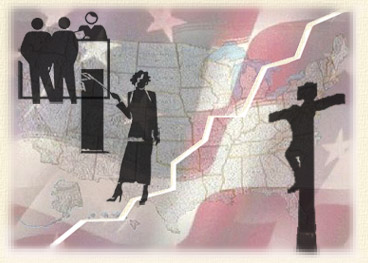
"Perhaps, though, you feel somewhat ambivalent about government. You applaud some of what you see but you are disgusted by other activities. Your convictions about judicial decisions relating to unborn infants, pornography, and sexual values may cause you to have some struggles in your relationship with the legal authorities. You may believe that the laws are unjust, taxes are too high, or money is misused. Although you wouldn't want to overthrow the government, maybe you have written notes of protest to your public leaders, have been involved in picketing against government policies, or have participated in acts of civil disobedience - and you may have wondered if you were right to do so.
On the other hand, you may find it easy to praise the government for its efforts to uphold freedom, justice, and good morals. If you enjoy a comfortable relationship with the political system and agree with the laws of the land, you may feel that you can honor and obey the government without having to be caught between what God says is right and what man says is necessary.
Then there are other people who try to pretend that government doesn't exist. They have chosen the road of apathy and noninvolvement. They think that a Christian should wipe his hands clean of the political process. They think that our allegiance is to God, not man. They think that government officials aren't worthy of our prayers.
He went on to ask
"Should we respect leaders and political systems even if we believe they are godless and corrupt? Is flag-waving patriotism a form of idolatry? Do we have the right to withhold taxes if we don't think our government is using the money wisely? Should people who have pledged allegiance to Christ become involved in politics, or should we distance ourselves from the process? How can we pray for our leaders, even if we don't like them?"
When all is said and done, it is to the Bible we must turn to find what our attitude and action should be toward the government "What does the Bible say about our attitude toward our political leaders, taxes, becoming involved in the system, and even the value of praying for governmental leaders". Government can seem like a necessary evil. In fact, it sometimes seems as if we could do better without it. Why then do we tolerate government?
Respect
We may find it easy to respect government leaders who are honest, just, and who uphold biblical morality. But what about leaders who lie, who pass laws for personal gain, and who hold opposite political views from us on just about everything? According to the Bible, all government leaders deserve our respect.
The key Scripture on this topic is Romans 13:1-7. Take a moment to read the passage and notice what it says about why we need government, who gives government its authority, and what is the rightful role of government.
Let every soul be subject to the governing authorities. For there is no authority except from God, and the authorities that exist are appointed by God. Therefore whoever resists the authority resists the ordinance of God, and those who resist will bring judgment on themselves. For rulers are not a terror to good works, but to evil. Do you want to be unafraid of the authority? Do what is good, and you will have praise from the same. For he is God's minister to you for good.
But if you do evil, be afraid; for he does not bear the sword in vain; for he is God's minister, an avenger to execute wrath on him who practices evil. Therefore you must be subject, not only because of wrath but also for conscience' sake. For because of this you also pay taxes, for they are God's ministers attending continually to this very thing. Render therefore to all their due: taxes to whom taxes are due, customs to whom customs, fear to whom fear, honor to whom honor.
Paul was telling his readers that "The authorities that exist are appointed by God". Although there are repressive and God-denying governments that have perverted their divinely appointed roles, God intended government for noble purposes.
Thus we are to recognize the authority of the government and submit to it that involves obedience to the laws that are established by those in authority. However, there are limits to obedience - being subject to leaders does not mean that a believer must blindly obey everything. And certainly not if it means being involved in immoral or unjust actions.
"There are times when we must disobey those in authority over us. God is the ultimate authority, the Final Judge, the Highest King. All rulers must answer to Him. We must obey Him first and last and all the time in between." (Kurt De Haan)
The apostle Peter gave us perhaps the best statement of a principle to follow when he said, "We ought to obey God rather than men" (Acts 5:29). Peter made that comment because the religious leaders (who had a great deal of power over Jewish life even under the rule of the occupying Roman forces) were trying to get him to stop speaking publicly about Christ. Peter and John had previously told the authorities that if it came down to whether they would obey God or man, they would obey God (Acts 4:19-20).
"The Bible gives us several examples of people who resisted evil government policies.
The midwives in Egypt refused to murder the newborn Hebrew boys (Exdus 1:15-21).
Moses asked Pharaoh for permission to let the Israelites leave Egypt. Moses wouldn't take no for an answer because he knew he was doing God's will (Exdus 2 - 7).
Daniel participated in various government administrations, but he drew the line when asked to violate his religious convictions (Daniel 1,6).
Shadrach, Meshach, and Abed-Nego refused to participate when the king ordered all citizens to become idolaters (Daniel 3).
Rahab refused to be part of the resistance to the invasion of God's people (Joshua 2). God was clearly with the conquering Jews.
Amos spoke out during a time of judicial corruption (5:7), immorality (2:7), and oppression of the poor (2:6-8; 4:1; 5:10-12; 8:4-6).
Queen Esther disobeyed official protocol in an effort to save her people from annihilation demanded by unjust laws promoted by evil men (Esther 5).
Paul sought to obey those in authority, even suffering unjustly, though he refused to keep his mouth shut about Jesus Christ (Acts 13 - 28).
Peter operated within the systems of authority except when forced to choose between obedience to God or to men (Acts 4:19,20; 5:29).
John the Baptist spoke out against the immoral lives of king Herod and his wife, even though he faced prison (Matthew 14:1-12)"
"Can we honor the government's authority and God's rule at the same time? I doubt that anyone would accuse Joseph of being an idolater because he was loyal to the Pharaoh and the Egyptian government (Genesis 39 - 50). Daniel certainly was not an idolater even though he faithfully served in the administrations of the powerful Babylonian and Persian empires.
It would definitely be a conflict of interest if the government required a form of patriotism that demanded loyalty that only God deserves". (Kurt De Haan)
"If you must disobey, do it respectfully. We must use every legal channel of expressing our protest. If we resort to anarchy to promote our cause - no matter how noble - we are violating the principle of submission to authorities".
Also Note: "The end does not justify the means. Violence, vandalism, and other destructive acts are to be avoided. Bombings, assassinations, harassment, and deceptive propaganda have no rightful place in pursuing biblical objectives." (Kurt De Haan)
What About Corrupt And Tyrannical Leaders?
"We have to remember that when the apostle Paul wrote his letter to the believers in Rome, they were living under the powerful and often immoral Roman rulers. Although Roman law was admirable in many ways, it was under Roman rule that Christians were to suffer some of their most severe persecution. The people to whom Paul wrote probably had seen the good and bad of government and were tempted to rebel against the Roman rule. Even after Paul himself had been imprisoned for his faith, he wrote to Titus and told him to remind believers "to be subject to rulers and authorities, to obey, to be ready for every good work" (3:1)".
Paul once had to face leaders who exercised both religious and civil authority (Acts 22:30 - 23:5). Even though he was mistreated, Paul upheld the principle that leaders should be respected.
Human governments can very well be used by Satan who is doing everything in his power to corrupt every element of society. In Old Testament times, he worked through the wicked nations that surrounded Israel to make them a constant source of danger to God's people. In New Testament times, Satan worked through the religious and political authorities to crucify Christ and persecute Christians.
Taxes
"Paying taxes is kind of like going to the dentist for a root canal. It's something that has to be done but it's oh, so painful! As the saying goes, two things are certain in human existence, death and taxes - and people will do anything they can to avoid both". (Kurt De Haan)
Why Should We Pay Taxes?
"Taxes have been a part of life as long as there has been any form of government because it costs money to provide protection and services for a group of people. We have to pay income tax, sales tax, gasoline tax, import tax, property tax, vehicle tax, road tax, social security tax, and on and on it goes. You just can't escape taxes."
"Some people question whether or not the government has a right to collect taxes. Other people question wh ether or not we should pay taxes if we don't like the way the money is being spent. Still others feel that giving money to a government that encourages ungodliness is the same as supporting ungodliness directly". (Kurt De Haan)
Jesus addressed the issue of taxation when He was questioned by representatives of two opposing viewpoints
The Pharisees who were champions of the Jewish religious tradition and resented Roman rule with its paganism and its deifying of the emperor.
The Herodians who felt that the Jews' best interests were accomplished through supporting the Herodian dynasty,
who asked Him whether it was permissible to pay a poll-tax to Caesar, or not? (Mark 12:14).
Jesus' answer probably took both parties aback. He said,
"Render to Caesar the things that are Caesar's, and to God the things that are God's" (Mark 12:17).
In other words, the Savior acknowledged the right of the government as the political authority to collect taxes but also stressed God's spiritual authority. He clearly implied that we should not give governments the worship and loyalty that only God deserves.
Paul: After mentioning our obligation to subject ourselves to the rulers, he wrote,
For because of this you also pay taxes, for rulers are servants of God, devoting themselves to this very thing. Pay to all what is due them: tax to whom tax is due; custom to whom custom; respect to whom respect; honor to whom honor. (Romans 13:6-7 NASB)
Should I pay taxes even if the government uses the money for unjust or immoral causes?
In his book God & Caesar, law professor John Eidsmore stated:
The Roman government of Paul's day deified Nero, ran a welfare state, and sponsored many pagan practices. Rome certainly did not use its tax money as Christians would desire. The tax-collectors of Jesus' time, who usually were paid no salary but rather became rich by overcharging and cheating people, certainly did not employ fair methods of taxation. Yet Jesus and Paul both spoke very clearly on the subject: the Christian ought to pay his taxes (p.37). (Kurt De Haan)
So from a biblical standpoint, "Christians have no justifiable excuse for cheating on their taxes, for misrepresenting their income, for filing false claims, or any other illegal means of not paying what the government demands. If we feel taxes are unjust or too high, we should do all we can legally to change the system".(Kurt De Haan)
Should We Try To Make Our Country A Christian Nation?
Regardless of how many Christians live here this country is not the present-day equivalent of ancient Israel
We can teach people how to be saved and follow God's laws but we cannot, and should not even try, to bring every aspect of society under "Christian' control as the perverted ideology of Dominionism is endeavoring to do.
Dominionism
is not a denomination but an umbrella term for a number of related groups (Kingdom Now, Manifest Sons of God/ Joel's Army, the Seven Mountain Mandate / Reconstructionism, Elijah Company, Overcomers, etc.) that the New Apostolic Reformation and similar organizations are based on. These groups are usually made up of conservative, often politically active supporters from a wide range of Christian denominations. In fact they are the most extreme faction of the Religious Right who believe that Christians have a divine mandate to take dominion over or control all aspects of society including the government thus preparing the world for Christ's return.
And that Christ will not, nay, cannot return to earth until this is accomplished. The 'kingdom' will then be handed to the returning Lord who apparently will only show up when it's all done and dusted.
Not only is the sheer arrogance of this man centered ideology staggering but it is having great impact on millions who have neither bothered to compare their teachings with what the Bible says, nor look into the very dark satanic roots of the movement.
It is entirely possible that their delusion will bring about the events prophesied to take place at the opening of the Fourth Seal when, as Jesus said, everyone who kills you thinks that he is offering service to God (John 16:2). (Yes, Matthew 24 and the Seven Seals of Revelation are parallel prophecies)
How Can We Make A Difference Right Now?
"Are we just supposed to sit back and let God's enemies dominate the political forces so that godlessness reigns? Are we to evangelize but not politicize? We've already mentioned that we are salt and light in the world, and the political world needs our influence. Here are some suggestions for involvement:
Be informed and think through the issues.
Speak out for what is true and just.
Vote whenever you have the opportunity.
Write to or speak with government officials.
Volunteer your time for good causes.
Give money to support the causes of justice.
Seek political office if you so desire.
Live a godly life.
Tell others about Jesus Christ.
Respect and obey the government.
Pray for political leaders". (Kurt De Haan)
How Involved Were People In Biblical Times?
Both the Old and New Testaments contain numerous examples of how believers influenced government. Here is a partial list:
Joseph rose to a position of great power in Egypt (Genesis 39 - 50). God used him to save many lives during a severe famine (Genesis 50:20).
Deborah, Gideon, Samson, and other judges were used by God to restore order and deliver the Jews from cruel oppressors during a period otherwise characterized by anarchy (Judges).
Samuel, Elijah, Isaiah, Jeremiah, Amos, Zephaniah, Haggai, and other prophets made sure that political leaders heard clearly what God had to say about justice, the right way to rule, caring for the widowed, the orphaned, the poor, and the lame.
Esther carefully used her position of influence to protect exiled Jews in Persia (Esther).
Nehemiah, who had become cupbearer to King Artaxerxes of Persia (464 - 424 BC), gained the king's help to rebuild Jerusalem (Nehemiah 16).
Daniel, an exiled Jew, gained respect as an intelligent administrator and as a godly man during the reigns of several kings. He was not afraid to speak out on God's behalf (Daniel 4:27).
John the Baptist spoke out against the immorality of king Herod and was imprisoned and then beheaded (Matthew 14:1-12).
The apostle Paul appealed to Roman law for protection when he was unjustly whipped and imprisoned without a trial, though he was a Roman citizen (Acts 22:22-30). (Kurt De Haan)
Should A Christian Go To War For His Country?
Because opinions on this issue are sharply divided - theologians falling hard on one or the other side it might be helpful to go into a few basic principles.
Although war is terrible in many way it is sometimes necessary as when a nation finds itself needing to defend itself against an aggressive enemy. And this is not the only reason.
The Scriptures tell us that in chapter four of the book that bears his name, Nehemiah was willing to fight to defend the rebuilding of Jerusalem. The war that Satan has waged often spills over into the physical realm - something we are involved with whether we like it or not. And its not over yet.
One day in the not too distant future God will unleash all His forces in a final battle to defeat Satan's army (Revelation 19 - 20).
Although no matter how noble the cause, taking a human life is a tragedy, the Old Testament clearly distinguished between murder and killing in war (Deuteronomy 5:17; 20:10-18). Thus soldiers on the battlefield are not committing murder but as representatives of the state, it is the state that bears final responsibility.
However, "we should not violate our conscience (Romans 14:22-23; 1 Timothy 1:5,19; 1 Peter 3:16-17). If we are ordered to join an army like Hitler's, do we fight for him or refuse? Do we carry out orders to exterminate thousands - even millions - of innocent men, women, and children? If the government asks us to go to war and we cannot in good conscience participate, we should seek exemption from the battle. Some countries allow such exclusion and allow civil service for the government as an alternative. In other nations such a person would be treated as a traitor. If our convictions conflict with government demands, we must be willing to take the consequences". (Kurt De Haan)
Pacifism
"When Jesus talked about turning the other cheek, He was not encouraging pacifism on the national level (Matthew 5:39-48). Rather, He was discouraging vengeance and retaliation when we are personally insulted." (Kurt De Haan)
Also note Jesus did not say, "Blessed are those who pick fights or start wars" but "Blessed are the peacemakers" (Matthew 5:9).
Our goal should be peace, both on a personal and a national level, even though there will be times when self-defense is justified.
Prayer
Paul believed that prayer that included government leaders who exercise a degree of authority over us could improve our lives. His words...
I exhort first of all that supplications, prayers, intercessions, and giving of thanks be made for all men, for kings and all who are in authority, that we may lead a quiet and peaceable life in all godliness and reverence. For this is good and acceptable in the sight of God our Savior, who desires all men to be saved and to come to the knowledge of the truth (1 Timothy 2:1-4).
...pretty much echoed what Jeremiah said so long ago
This is what the LORD of armies, the God of Israel, says to all the exiles whom I have sent into exile from Jerusalem to Babylon: ‘Build houses and live in them; and plant gardens and eat their produce. ‘Take wives and father sons and daughters, and take wives for your sons and give your daughters to husbands, so that they may give birth to sons and daughters; and grow in numbers there and do not decrease. 'Seek the prosperity of the city where I have sent you into exile, and pray to the LORD in its behalf; for in its prosperity will be your prosperity.’ (Jeremiah 29:4-7 NASB)
Four Kinds Of Prayer
In 1 Timothy 2:1 above Paul said "supplications, prayers, intercessions, and giving of thanks be made for all men".
The first three words bear similar descriptions
Supplication essentially means to ask for humbly or earnestly - to beseech. Very often supplication arises from a need in a specific situation.
Prayer is communicating with God which can include making a reverent petition to Him
Intercession is an entreaty in favor of another, especially a prayer or petition to God in behalf of another
Giving of thanks: Instead of solely concentrating on what is wrong or in need of improvement, we need to take more time to thank God for all the good things that we have in our particular country.
Specific Issues
"We need to pray in general terms for matters such as the upholding of justice, freedom for the oppressed, protection of citizens, efforts against crime, free exercise of religion, economic health and stability, and unhindered ability to communicate the gospel to those who have never heard.
We also need to pray for specific issues such as a particular piece of legislation, an election issue, candidates, specific court cases we become aware of, and much more". (Kurt De Haan)
If The Leaders Are Evil, How Am I Supposed To Pray For Them?
Are we to support evil, corrupt leaders with our prayers? Although we can continue to pray that God would work in their lives so that they would govern wisely and promote truth and justice but Prayers against such people - leaders or otherwise are appropriate.
The Psalms include many prayers against those who were wicked, unjust and violent. And David wasn't polite about it either. For example, he asked the Father to
"shatter their teeth in their mouth; Break out the fangs of the young lions" and "flow away like water that runs off". He added that the "righteous will rejoice when he sees vengeance; He will wash his feet in the blood of the wicked." (Psalm 58, V. 6-7 and 10)
And in Psalm 109 he railed against those who returned evil for good and persecuted the afflicted and needy person,
May his days be few; May another take his office. May his children be fatherless, And his wife a widow. May his children wander about and beg; And may they seek sustenance far from their ruined homes. May the creditor seize everything that he has, And may strangers plunder the product of his labor. May there be none to extend kindness to him, Nor any to be gracious to his fatherless children. May his descendants be eliminated; May their name be wiped out in a following generation. May the guilt of his fathers be remembered before the LORD, And do not let the sin of his mother be wiped out. May they be before the LORD continually, So that He may eliminate their memory from the earth;(Psalms 109:8-15 NASB)
Additionally, Jeremiah was told by God not to pray for people who were making sacrificial cakes for the queen of heaven; and pouring out drink offerings to other gods (Jeremiah 7:16)
As for you, do not pray for this people, and do not lift up a cry or prayer for them, and do not plead with Me; for I am not listening to you. (Jeremiah 7:16 NASB)
Misdirected Hopes
In the long run let's not fool ourselves. Government - even good government - does not hold the ultimate answers to our social and personal problems. No political system, no leader, no parliament or congress, can create the type of society that meets our most fundamental needs.
The opening phrase of the Preamble to the U.S. Constitution, written in 1787 clearly communicates the intentions of the framers and the purpose of the document.
We the people of the United States, in order to form a more perfect union, establish justice, insure domestic tranquility, provide for the common defense, promote the general welfare, and secure the blessings of liberty to ourselves and our posterity, do ordain and establish this constitution for the United States of America.
Goals that have long fallen by the wayside.
If we're looking for a government that can and will actually fulfill those goals, we will look long and hard - in vain.
If as Kurt De Haan wrote
we're looking to our Constitution and our leaders to give us a sense of security and well-being, we're not looking high enough. Only the King of kings, the ultimate Ruler of the universe, has the ability to fulfill all these needs and desires. Our high hopes must be centered on the One who is called God Most High (Ps. 57:2).
However, our tendency to expect too much from government is an age-old problem. Take ancient Israel for example. In 1 Samuel the people said this to him
Behold, you have grown old, and your sons do not walk in your ways. Now appoint us a king to judge us like all the nations.” (1 Samuel 8:5 NASB)
Following the instructions of the Lord, Samuel warned them of the consequences of having a king rule over them. (Vs. 11-18) which however, did not deter the people in the slightest. They wanted to
... be like all the nations, and our king may judge us and go out before us and fight our battles.” (1 Samuel 8:20 NASB)
So the Lord gave them what they wanted and appointed the seemingly impressive Saul as king. And we all know what kind of a king he was.
What we long for from a good government is ultimately fulfilled only in God who offers protection that will not fail. He alone can protect us, provide for our needs, give us worthy work, ensure justice, provide infallible leadership, educate us with eternal truths, and provide lasting peace, an abundant life, true liberty, and enduring happiness.
Even David who became king of Israel, recognized that his ability to rule well and his nation's security were not in his own power to provide. He wrote, "The Lord is my rock and my fortress and my deliverer; my God, my strength, in whom I will trust" (Ps. 18:2). He also wrote, "Some trust in chariots, and some in horses; but we will remember the name of the Lord our God" (20:7).
Provision. We often see the state as being the one who provides us with food. Yet the Lord demonstrated by His miraculous supply of manna and water in the wilderness during the exodus of the Jews from Egypt that He can provide food and drink when no one else can. Jesus taught us to recognize God as our ultimate Provider when He told us to pray, "Give us this day our daily bread" (Matthew 6:11).
Justice. Our judicial systems are flawed by prejudice, incomplete evidence, political power, even bribery. Even the best courts struggle with sorting out truth, bringing about justice, and trying to close up loopholes that allow the guilty to go free.
We do not as yet see God's justice but "He has appointed a day on which He will judge the world in righteousness by the Man [Jesus] whom He has ordained.
Life, Liberty, and Happiness. The United States Declaration of Independence declares that all people "are endowed by their Creator with certain inalienable rights, that among these are life, liberty, and the pursuit of happiness." The government is supposed to uphold and protect these rights.
"Governments come and governments go but the Lord remains the same. He alone fulfills our deepest needs and provides the kind of protection, provision, justice, life, liberty, and happiness that can satisfy us both now and forever. He alone is the King who deserves our pledge of absolute allegiance. He alone has the ability to fulfill our highest hopes."
See What and Where is Heaven?
Christians who believe they will spend an eternity in "heaven" seem to have little or no idea where this heaven is, what it will look like, or what they will do once they arrive. Either they have vague, half formed ideas about some ethereal place 'out there' or resort to pious phrases that amount to little more than spiritual gobbledy gook. If this is the best we can do then it is little wonder that non Christians are not in the slightest bit interested in our "heaven" and Christians themselves so rarely seem to look forward to the coming of the kingdom of God.
Luckily the Bible isn't at all silent on where "heaven" is and, even more importantly, what it will be like. In fact, the Bible's description of the coming kingdom is far, far, more practical than that of our theologians. Additionally, many Christians have the erroneous idea that since all our sins have been forgiven, our works cannot possibly be considered at some future time. Not true according to I Corinthians 3:9-13. Apparently there are those that will make it to heaven but have earned few, if any, additional rewards.