ON THIS PAGE
Catholicism and Protestantism - Defining The Terms
The Differences
1. The Bible
2. Sola Scriptura
3. Salvation: Faith Alone or Faith Plus .... ?
4. Baptism
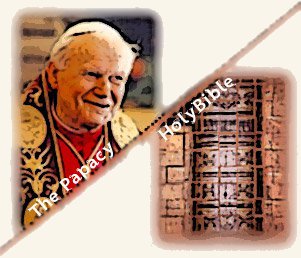
5. The Pope
6. The Eucharist vs. Communion:
7. Mary
8. Praying to Saints
9. Purgatory
10. Confession
11. Holy Relics: Objects of Veneration or Idolatry?
Catholicism and Protestantism - Defining The Terms
Catholicism: Although the word "Catholic" means broad scope; comprehensive, universal or all-embracing, it also refers to the Catholic Church that, under the leadership of the pope, sees itself as the only true church.
Protestantism is a broad umbrella term for any Christian group that separated from the Catholic Church, including Baptists, Lutherans, Methodists, Episcopalians, Presbyterians etc.
Evangelicalism: Derived from the Koine Greek word euangelion, meaning "good news ie. the gospel. is a specific, theologically conservative movement within Protestantism defined by a strong emphasis on the infallibility and authority of the Scriptures, personal conversion through faith in Christ, being "born again", and the spreading of the Gospel. Mainline Protestants are simply non-evangelical Protestants.
See Born Again'
Almost everyone talks about being born again, but virtually no one seems to know what the Word of God teaches about this new birth.
Although there have been widespread efforts at reconciliation between Catholics and Protestants, the CRUCIAL differences between what the Bible teaches and what the Catholic Church teaches are irreconcilable.
In fact, the Canons and Decrees of the Council of Trent, that rejected every doctrine of the Reformation and hurled 125 anathemas (curses or denunciations) against every belief held by Bible believing Christians, remains the standard authoritative statement of Catholicism. See The Council of Trents Anathemas.
Here are some of those difference with, in most cases, links to detailed articles
The Differences
1. The Bible
Catholicism: In addition to the 66 books in the Protestant Bible Catholic Bibles include 1 and 2 Maccebees, Tobit, Judith, Sirach, Wisdom and Baruch.
See The Canon of Scripture
How can we trust that the 66 books of the Bible that we so rely on today is exactly what the Father intended to be the complete canon?
2. Sola Scriptura
The Catholic Church argues that the Bible does not teach the doctrine of Sola Scriptura inasmuch as it neither explicitly nor implicitly says it is the Christians only authoritative guide. Thus Catholicism maintains that the teaching authority of the church and tradition are commensurate with the Scriptures. The Catholic Catechism says the following
"Both Scripture and Tradition must be accepted and honoured with equal sentiments of devotion and reverence." [01]
Protestants on the other hand maintain that everything a Christian knows about God and everything he believes and practices, is based solely on God's Word to man as recorded in the Scriptures. Because the Bible is God's inspired Word and He alone is its author it is all-sufficient and the only infallible authority in all matters regarding the Christian faith.
See Sola Scriptura (Scripture Alone)
3. Salvation: Faith Alone or Faith Plus .... ?
Perhaps the most crucial difference lies in how salvation is achieved.
Catholicism teaches that salvation is a lifelong process involving faith, good works, and participation in the sacraments - the latter said to be 'the chief means of our salvation' (cf. Catechism of Christian Doctrine [CCD] n. 252).
"They (the sacraments) are efficacious because in them Christ himself is at work: it is he who baptizes, he who acts in his sacraments in order to communicate the grace that each sacrament signifies ... The Church affirms that for believers the sacraments of the New Covenant are necessary for salvation." (CCC 1129) [02]
Note The Catholic Church recognizes seven sacraments including Baptism, Confirmation, and the Eucharist. Protestants recognize the only two sacraments instituted by Jesus - Baptism and the Lord's Supper.
The Council of Trent adds,
"If anyone says, that men are justified, either by the sole imputation of the justice of Christ, or by the sole remission of sins, to the exclusion of grace and charity that is poured forth in their hearts by the Holy Ghost, and is inherent in them; or even that the grace, whereby we are justified, is only the favor of God: let him be anathema." [03]
James McCarthy author, Bible teacher, and apologist who was brought up in the Catholic faith adds
The Catholic way of salvation was so complicated. In addition to what Jesus had done to save me, the Church taught that I had to do my part to be saved. I needed to receive the sacraments, attend Mass, pray, keep the Commandments, confess my sins, do good to others, die in a state of grace, and more. Somewhere amidst it all, the sufficiency and centrality of Christ in salvation were obscured - if not lost. [04]
See The Salvation Requirements of the Catholic Church
In Protestantism, salvation or the deliverance from sin and its consequences comes about through faith in Jesus' sacrificial death and subsequent resurrection. It is not earned through good works, sacraments, or personal merit, but solely and wholly because of God's grace. Ephesians 2:8-9 reads
For it is by grace you have been saved through faith, and this not from yourselves; it is the gift of God, not by works, so that no one can boast.
However, the words "through faith" require clarification. Mental assent to Jesus' life, death, and resurrection is not enough to save a person. Salvation involves more than simply affirming in one's mind that Jesus is Lord and Savior it involves living a life of holiness or righteousness.
Holiness
It is a tragedy of gargantuan proportions that there is little or no emphasis on holiness in the modern church. It lies breathing its last buried below mega star preachers, flamboyant preaching, worship teams that could find work in many Broadway productions, large "crusades", exciting "revivals". In fact, one manmade creative program after the other - glitz and glamour that Hollywood could be proud of.
Yet the Bible says "Without Holiness, No Man Shall See God!" (Hebrews 12:14) in view of which
it would be wise to know exactly what it means by holiness.
Incidentally although Romans 5:15-16 and 6:23 include the phrase "free gift", I am sure it will surprise many to learn that the word "free" doesn’t exist in the original Greek. Additionally, the word "gift" may not mean exactly what we have been led to believe. HERE
Also See The Two Phase Atonement
The New Testament sometimes says that salvation is an accomplished reality but at other times says it is still in the future. This seeming contradiction is not limited to salvation alone but also occurs with confusing regularity in statements about other topics of crucial importance... justification, redemption, glorification, and adoption. Check it for yourself.
So what is the answer? Can we be assured we have salvation now or is it something we have to strive and hope for. Have we already been adopted as sons or are we waiting for this adoption? Are we righteous now or is it yet a distant hope?
For those who are actually interested in what the Scriptures have to say on the subject (as opposed to what parents, pastors, friends, or denomination may believe and teach) the answer to all of the above questions is .. BOTH. However, in order to understand when we are fully and finally saved we have to undertake an in-depth study of the Old Testament ritual of Yom Kippur and how it relates to our salvation.
4. Baptism
Catholicism teaches that "justification is conferred in Baptism." The waters of baptism wash away original sin and join us with Christ. Baptism is not merely a sign and seal of grace, but actually confers saving grace.
Protestants do not believe that in itself baptism can save a person or wash away original sin. Because it is a public declaration of faith, that is done after a person has made a conscious decision to follow Christ. Infants who cannot yet understand or choose for themselves are not baptized.
See Original Sin... Fact or Fable
Many Christians today including most Anglicans, Lutherans, Methodists, Presbyterians and Catholics unblushingly subscribe to the view that the sin of Adam was transferred to all future generations tainting even the unborn. This makes me wonder how many of those that profess to believe in Original Sin have given any thought to the fact that sin is not a substance with physical properties that can be transmitted from person to person like a virus.
Much to the contrary, sin is a conscious, willful act performed by an individual (in thought, word or deed) that transgresses God's law. Think about it - sin can not even exist unless a sinner has an immoral, unrighteous thought then acts on it. Besides which, if sin can be inherited there is absolutely no reason why virtue, goodness, and righteousness cannot also be passed on.
Baptism
5. The Pope
Catholicism: The Catholic Church is led by the Pope in Rome who is believed to be Peter's spiritual successor.
They claim they can trace their lineage back to Peter whom they believe was the "first" pope. Just as the high priest had to be a Levite and a descendant of Aaron in the Old Testament, the pope is said to be a spiritual "descendant" of Peter by virtue of 'apostolic succession'.
Moreover, it is believed that Jesus conferred supreme power on Peter and his successors in all matter pertaining to the Christian faith. In other words, what the pope says - goes. Based on the concept of 'Apostolic Succession', the pope is considered infallible when he makes official doctrinal pronouncements known as speaking "ex cathedra" (from the chair).
According to the Catholic Catechism,
"The task of giving an authentic interpretation of the Word of God, whether in its written form or in the form of Tradition, has been entrusted to the living teaching office of the Church alone ... This means that the task of interpretation has been entrusted to the bishops in communion with the successor of Peter, the Bishop of Rome. [05]
See Apostolic Succession
Protestants reject the authority of the Pope and emphasize individual interpretation of the Bible. However, regardless of personal opinion there is only one right interpretation of any and all passages in the Scriptures and it is our job to dig deeply in order to get to the truth of what it is telling us. One thing that may help us is to remember that...
Context is CRUCIAL
6. The Eucharist vs. Communion: Understanding Transubstantiation
The Catholic Church holds that Jesus Christ's sacrifice on the cross is re-presented every time the Mass is offered. The words of consecration is said to transform the bread and wine into the actual Body and Blood of Jesus which is received in Catholic communion and is how redemption is accomplished.
One Catholic priest/author goes as far as to say
When the priest announces the tremendous words of consecration, he reaches up into the heavens, brings Christ down from His throne, and places Him upon our altar to be offered up again as the Victim for the sins of man. It is a power greater than that of saints and angels, greater than that of Seraphim and Cherubim.
Here is a thought : If a person really believed that they were in the presence of the Lord God they would never get up off their knees, much less turn their back on Him and walk out.
Protestants believe that Jesus instituted the Lord's Supper as a memorial not a sacrifice. It recalls the person of Christ and the unbelievably great service that He did for us on Calvary. The Lord's Supper also serves as a forward-looking proclamation, reminding the church to anticipate Jesus' eventual return and the eternal heavenly banquet.
See Transubstantiation
7. Mary
In Catholicism Mary is commonly know as "Queen of Heaven" and is often called upon by the titles of Advocate, Benefactress, and Mediatrix. Although Catholics vehemently deny that they worship Mary, the actions of many Catholics including several of the popes contradict what they say.
See Queen of Heaven? and Mary Worship
One of the foundational doctrines in the Catholic Church is known as the Immaculate Conception. It states that from the very moment of her creation in her mother's womb, Mary was preserved immune from the stain of original sin. It is also believed that she stayed a virgin the rest of her life, and at the end of it all "was taken up body and soul into heaven -
See Mary - Perpetual Virgin? The Immaculate Conception and the Assumption.
Although various Catholics have made some ridiculously elaborate claims about Mary we do not need to overlook the fact that she was quite an amazing young woman. I find it wryly amusing that it was a Protestant that drew my attention to the qualities that the Bible attributes to her, rather than the inane flights of fancy that are indulged in. (It seemed like all too many of the early church fathers preferred rhetoric to Biblical truths. Elaborate, pretentious ideas and speech trumped accuracy).
So what, according to the Scriptures, was so special about Mary?
See The Real Mary of The Bible
8. Praying to Saints
Catholicism: One of the significant differences between Catholicism and Protestant Christianity is the practice of praying to saints. Catholics tend to believe there's value in praying to deceased saints who can intercede on their behalf.
Protestants: This practice is widely rejected by Protestant denominations many of whom some view the veneration of images/statues as idolatry.
Protestants not only hold that prayer should be directed solely to God but also pay heed to Paul's teaching that Jesus is the sole mediator between God and humanity.
For there is one God, and there is one mediator between God and men, the man Christ Jesus, (1 Timothy 2:5 BSB)
See Praying to Saints
9. Purgatory
The Catholic Church believes in an intermediate state in which souls undergo purification before entering heaven. Though Jesus has forgiven our sins, we still need to be cleansed of our sins and, since God cannot countenance evil, He can't have evil in a perfectly good heaven (in other words a heaven where there is perfect goodness and there is no moral flaw).
Therefore, we cannot enter heaven in a position of moral inadequacy and we must go through a period of purging in which our sins and our sinful character is purged and perfected and transformed so that we might enter heaven in perfection.
This doctrine commends the non-biblical practices of praying for the dead and has led to alms giving, indulgences, and works of penance undertaken on behalf of the dead.
Protestants find absolutely no support in Scripture for this doctrine, but plenty for the belief that believers go directly to be with the Lord (2 Corinthians 5:8) when they die.
See Is There a Purgatory?
Unfortunately most Christians - be they Catholic or Protestant - have little idea of what or where heaven is, and both sides are completely off base when it comes to Hell. Links to both articles below.
10. Confession
In Catholicism, confessing sins to a priest is a sacrament. Catholics believe that priests have been given authority by Christ to forgive sins, based on their interpretation of John 20:21-23.
Protestants believe in the priesthood of all believers and that confession should be made directly to God. While James 5:16 encourages us to confess our sins to one another, this is for accountability and support, not for forgiveness, which comes from God alone.
See Confession
11. Holy Relics: Objects of Veneration or Idolatry?
In Catholicism objects such a martyr's bones, crucifixes, holy water, or statues of saints become the focus of veneration or are seen as a means to get closer to God
Protestants see this as a potential violation of the second commandment which forbids creating or worshiping idols.
What And Where is Heaven
Christians who believe they will spend an eternity in "heaven" seem to have little or no idea where this heaven is, what it will look like, or what they will do once they arrive. Either they have vague, half formed ideas about some ethereal place 'out there' or resort to pious phrases that amount to little more than spiritual gobbledy gook. If this is the best we can do then it is little wonder that non Christians are not in the slightest bit interested in our "heaven" and Christians themselves so rarely seem to look forward to the coming of the kingdom of God.
Luckily the Bible isn't at all silent on where "heaven" is and, even more importantly, what it will be like. In fact, the Bible's description of the coming kingdom is far, far, more practical than that of our theologians. Additionally, many Christians have the erroneous idea that since all our sins have been forgiven, our works cannot possibly be considered at some future time. Not true according to I Corinthians 3:9-13. Apparently there are those that will make it to heaven but have earned few, if any, additional rewards.
What and Where is Hell?
The belief that Hell is a place of unending torment has been so strongly held throughout the history of Christianity that few have dared to challenge it. Anyone who dares to question the traditional viewpoint runs the risk of being labeled a cultist. However, the deeper one delves into the subject the less persuasive the argument in favor of the traditional view become.
If eternal punishment in an unending hell is true it means that everyone has eternal life - it is only a matter of where each one will spend it. Note that in Matthew 19:16 the man who approached Jesus asked what he had to do to obtain eternal life, not what he had to do to ensure he spent it in a good place. This makes perfect sense in light of the fact that in innumerable passages the Bible clearly states that eternal life is a result of redemption. Besides which, one has to play word games in order to believe in the traditional view of hell - i.e take the word "death" to mean eternal life in hell, and the word "perish" to mean "never perish".
However, it is totally pointless to embark on a investigation unless one is prepared to set aside one's denominational presuppositions and other biases and rely strictly on what the Word says. This seems to be easier said than done
for many, if not most Christians.
End Notes
[01] The Holy See. II. The Relationship Between Tradition and Sacred Scripture. https://tinyurl.com/bd85tc5e
[02] The Holy See. The Sacraments of Salvation. https://tinyurl.com/mr4c2fv6
[03] General Council of Trent: Sixth Session. Page 46.
https://www.papalencyclicals.net/councils/trent/sixth-session.htm. CANON XI
[04] James McCarthy. Author Profile https://www.jimmccarthyapologetics.com/about-us/
[05] The Holy See. The Interpretation of the Heritage of Faith. https://tinyurl.com/f93ueajt
|