|
Emphasis Mine In Bible Verses
Also See Should Christians Celebrate the Jewish Feasts?
And Rod Parsley's Self Serving and Deviant Interpretation of the Feasts of Israel
Unbelievably, amid numerous erroneous statements about all the Feasts, Rod Parsley manipulates the meaning of The Day Of Atonement - the holiest day on the Jewish calendar - to elicit money from his extremely gullible listeners who blindly believe his heretical bilge without checking it for themselves. In fact, his version of the Feasts of Israel shows nothing but an EXTREMELY shallow and self serving interpretation of these holy convocations that took place at "appointed times" initiated by the Father Himself. This will cost him dearly.

ON THIS PAGE
Introduction
The Weekly Sabbath and The High Sabbaths
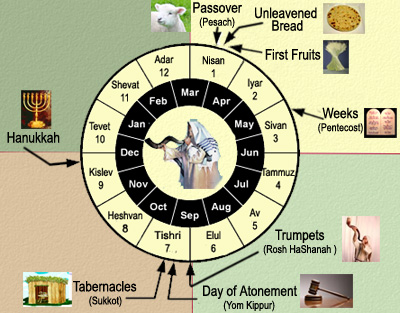
Overview of The Seven Feasts of Israel
The First Four Feasts
1. Pesach or Passover
2. Unleavened Bread
3. First-fruits
4. Shavuot the Festival of Weeks
The Remaining Three Feasts
5. Rosh HaShanah or The Feast of Trumpets
6. Yom Kippur or The Day of Atonement
7. Sukkot or The Feast of Booths
The Eighth Festival
Chanukah
Why the Jewish Feasts Move Around on the Calendar
Introduction
Shabbat - The Weekly Sabbath
People who neither understand nor are not familiar with the Sabbath think of it as either a day of prayer or perhaps even a day of stifling restrictions. However, the word "Sabbath" comes from the Hebrew Shabbat - to cease, to end, or to rest.
It was the only ritual observance instituted in the Ten Commandments and is considered extremely important even in modern Judaism being a day of not only rest, but of prayer and spiritual enrichment - "a day of great joy eagerly awaited throughout the week, a time when we can set aside all of our weekday concerns and devote ourselves to higher pursuits." [01]
The Sabbath that was (and is) observed every week from sundown on Friday to sundown on Saturday has a two fold significance. 1) It is a remembrance of creation inasmuch as the Israelites were to imitate God's example and rest on the seventh day. 2) It is also meant to be a remembrance of the nation's deliverance from the bondage of Egypt.
1. So the sons of Israel shall observe the Sabbath, to celebrate the Sabbath throughout their generations as a perpetual covenant.' "It is a sign between Me and the sons of Israel forever; for in six days the Lord made heaven and earth, but on the seventh day He ceased from labor, and was refreshed." (Exodus 31:16-17 NASB)
2. 'You shall remember that you were a slave in the land of Egypt, and the Lord your God brought you out of there by a mighty hand and by an outstretched arm; therefore the Lord your God commanded you to observe the Sabbath day." (Deuteronomy 5:15 NASB)
Remembering that they were once slaves in Egypt, they were to give themselves and their bond servants a day of complete rest (Exodus 20:10) - a radical concept in ancient times.
but the seventh day is a Sabbath of the Lord your God; in it you shall not do any work, you or your son or your daughter, your male or your female servant or your cattle or your sojourner who stays with you. (Exodus 20:10 NASB)
The Sabbath was considered a day of joy so no work was done nor did anyone fast. Meals, cooked the day previous, were often more elaborate and eaten more leisurely.
The High Sabbaths:
The regular Sabbath was a weekly occurrence however, there were seven annual or High Sabbath days that did not necessarily extend from Friday to Saturday but were related to the annual feast days as listed in Leviticus 23.
For example, the first and last days of the seven day Feast of Unleavened Bread, the day of Pentecost (Shavuot), the Day of Trumpets (Yom Teruah or Rosh HaShanah), the Day of Atonement (Yom Kippur), and the first day of the seven day Feast of Tabernacles (Succoth) were all High Sabbaths. The Passover and the Feast of First Fruits were not.
Overview of The Seven Feasts of Israel:
The Seven Feasts were introduced to the nation of Israel when they were encamped at the foot of Mount Sinai. The fact that God Himself instituted them made these Feasts hugely important in the Israeli calendar. They were holy convocations that took place at "appointed times". Although they are referred to in several places in the Bible, only Leviticus 23 lists all seven feasts in chronological order.
Note: The feasts are celebrated on the same day of the Jewish calendar every year, but since the Jewish year is not the same length as a solar year on the Gregorian calendar used by most of the western world, the date shifts on the Gregorian calendar. Details
The historic and prophetic significance of the Feasts is one of the most fascinating of all Biblical studies. Although believers are not required to keep them, every Christian should be very familiar with the Feasts because they not only celebrate a historical event in Israel's past but are also a prophecy of future events that concern us all. They were types that, in Christian theology, were actual historical events that were a rough draft or a glimpse, of one or more events yet to occur culminating in one final and very important event called the antitype.
The Jews probably just related these feasts to past historical events (Passover for example) or (except for Yom Kippur) to a celebration of the agricultural seasons. However, at the time they were given every one of the feasts pointed to something incomprehensibly bigger that was yet to come. In fact, and quite fascinatingly, God's entire plan of salvation from start to finish is outlined by these feasts that were also related to Israel's agricultural seasons. The Spring and Summer Feasts signified the commencement of redemption - the Fall Feasts signify its culmination.
"The first three feasts Passover, Unleavened Bread, and First Fruits occur in rapid succession in the spring of the year over a period of eight days. They came to be referred to collectively as "Passover."
The fourth feast, Harvest occurs fifty days later, at the beginning of the summer. By New Testament times this feast had come to be known by its Greek name, Pentecost, a word meaning fifty.
The last three feasts Trumpets, Atonement, and Tabernacles extend over a period of twenty-one days in the fall of the year. They came to be known collectively as Tabernacles." [02]
The first four feasts have already been fulfilled. The first two by Jesus Christ on the actual feast days according to the Hebrew calendar... He was sacrificed on Passover and resurrected on the Feast of First Fruits. The third Feast of Unleavened Bread had great significance in light of His sacrifice, and the Fourth Feast Shavuot (the Festival of Weeks) was again fulfilled on the exact day of Pentecost.
While we certainly do not know exactly how the other three feasts will be fulfilled, it is impossible that they will not be fulfilled on the actual feast day.
Besides which, the Feasts that symbolize a sequence of events were given by God in a set chronological order. Therefore the events that they symbolize will take place in the same exact order. I have read way too many interpretations of the Feasts that jump backwards and forwards between them in an effort to make them fit into pre-conceived end time scenarios. What we need to do is make the order of the Feasts our guideline to coming events, instead of scrambling them to fit our ideas.
The First Four Feasts
1) Pesach or Passover:
In the first month, on the fourteenth day of the month at twilight is the Lord's Passover (Heb. Pesach). (Leviticus 23:5)
The Type
The Hebrew word Pesach means to pass over, to exempt, or to spare. Passover, which begins on the 14th day of Nisan (the first month of the Jewish calendar) celebrates the deliverance of the nation of Israel from slavery under the Pharaohs and their dramatic exodus from Egypt.
The Jews had been slaves in Egypt for generations but were refused their freedom despite plague after plague being visited on them by the Almighty through Moses. However, the final straw that caused the Pharaoh to change his mind came when, after weeks of back and forth, the Israelites were given very explicit instructions - They were to sacrifice a lamb and put some of the blood on the door posts and lintels of their homes. That night the angel of God "passed over" the houses of the Jews that marked by the lamb's blood but caused the death of the first-born of all families in the houses that were not. (Exodus 12)
The Antitype
Jesus fulfilled this feast both symbolically and quite literally.
He rode into the city of Jerusalem on the 10th of Nisan - the very day the lambs to be slaughtered were selected - He entered the city as the sacrificial Lamb chosen by God. Four days later Jesus was crucified on the day of preparation for the Passover which was when the lambs were actually slaughtered. See John 19:14.
The Passover lamb was to be a "male without defect" which is how Jesus was described.
knowing that you were not redeemed with perishable things like silver or gold from your futile way of life inherited from your forefathers, but with precious blood, as of a lamb unblemished and spotless, the blood of Christ. (1 Peter 1:18-19 NASB)
Additionally, unlike most people who were crucified, Jesus' bones remained unbroken. It was customary to break the leg bones of the person after a few hours of crucifixion so that the person could not push up with their legs in order to breathe. Breaking the legs ensured that death by asphyxiation followed very quickly. However, while the Romans broke the legs of the two thieves crucified on either side of Jesus, they did not touch Jesus who was already dead. (John 19:31-34)..
And, in yet another testimony to the Divine origin of the Scriptures, many centuries earlier one of the Old Testament stipulations for the Lamb eaten on the Passover was that none of it's bones were to be broken.
"It is to be eaten in a single house; you are not to bring forth any of the flesh outside of the house, nor are you to break any bone of it. (Exodus 12:46 NASB)
However the full extent of the symbolism is only realized when viewed from a Christian perspective. When John the Baptist
... saw Jesus coming to him and *said, "Behold, the Lamb of God who takes away the sin of the world! (John 1:29 NASB)
Paul reiterated this when he said "... For Christ our Passover also has been sacrificed" (1 Corinthians 5:7 NASB)
Just as the destroyer "passed over" every home in Egypt protected by the blood of the lamb, so God will "pass over" (not execute judgment) on every believer protected by the blood of the lamb Jesus. This is what the Bible means when it uses the word Salvation
2. Unleavened Bread:
'Then on the fifteenth day of the same month there is the Feast of Unleavened Bread to the Lord; for seven days you shall eat unleavened bread. 'On the first day you shall have a holy convocation; you shall not do any laborious work. 'But for seven days you shall present an offering by fire to the Lord. On the seventh day is a holy convocation; you shall not do any laborious work.'" (Leviticus 23:6-8 NASB)
The feast of Unleavened bread began on the 15th of Nisan (the day following Passover) and continued for seven days. The first and last days of this week long festival were High Sabbaths. The day prior to a High Sabbath was commonly known as a 'preparation day' which meant the Passover on the 14th of Nisan was also the preparation day for the "High Sabbath" on the 15th.
The Type
God commanded the Israelites to refrain from eating any leavened foods (food that contained any fermenting product such as yeast) during this festival which reflected the fact that the Israelites had no time to put leaven in their bread before their hasty departure from Egypt
The Egyptians urged the people, to send them out of the land in haste, for they said, "We will all be dead." So the people took their dough before it was leavened, with their kneading bowls bound up in the clothes on their shoulders. (Exodus 12:33-34 NASB)
Note that at least six Biblical passages (Exodus 12:14-20; 13:6-8; 23:15; 34:18; Leviticus 23:6; Deuteronomy 16:3, 8) mention the prohibition of leaven during the seven days of the Feast - the consequences of using any were severe.
'Now this day will be a memorial to you, and you shall celebrate it as a feast to the Lord; throughout your generations you are to celebrate it as a permanent ordinance. 'Seven days you shall eat unleavened bread, but on the first day you shall remove leaven from your houses; for whoever eats anything leavened from the first day until the seventh day, that person shall be cut off from Israel. (Exodus 12:14-15 NASB)
Even modern day Jews who observe the traditional feasts go through a thorough search of their houses for any form of leavened food (chametz) every last crumb of which is removed. This because leaven in the Bible always symbolized an evil influence of one kind or another. Both Jesus and Paul warned about leaven...
And Jesus said to them, "Watch out and beware of the leaven of the Pharisees and Sadducees." (Matthew 16:6 NASB) Also See Luke 12:1
And He was giving orders to them, saying, "Watch out! Beware of the leaven of the Pharisees and the leaven of Herod." (Mark 8:15 NASB)
Your boasting is not good. Do you not know that a little leaven leavens the whole lump of dough? (1 Corinthians 5:6 NASB)
The Antitype
The symbolism of the feast of Unleavened Bread is that God's people have to search for and remove every speck of sin in their lives.
Leaven was probably used as a symbol of evil because of the character and process of leavening which is based on fermentation. Given time the yeast reproduces spreading throughout the dough or batter and biologically changing the chemistry of the dough as it works. Sin, like leaven, has a polluting quality. It doesn't stay small or contained for very long, but spreads very rapidly. As Paul asked the Galatians who were turning from the truth of the Gospel to doctrine preached by false teachers.
You were running well; who hindered you from obeying the truth? This persuasion did not come from Him who calls you. A little leaven leavens the whole lump of dough. (Galatians 5:7-9 NASB)
3. Firstfruits :
Then the Lord spoke to Moses, saying, "Speak to the sons of Israel and say to them, 'When you enter the land which I am going to give to you and reap its harvest, then you shall bring in the sheaf of the first fruits of your harvest to the priest. 'He shall wave the sheaf before the Lord for you to be accepted; on the day after the sabbath the priest shall wave it. (Leviticus 23:9-14 NASB)
The Type
The Feast of First-fruits on the 17th day of Nisan was a celebration of the harvest. On that day a sheaf representing the very first of the harvest was waved by a priest before the Lord as a symbolic gesture of a thankful acknowledgment to God as the giver of the harvest and dedicating the coming harvest to Him. (This sheaf was likely to be barley still on the stalk, which was the first crop to ripen at the beginning of the spring harvest) The crop could not be harvested until the first sheaf was offered to the Lord.
The Antitype
Jesus’ resurrection from the dead on the Feast of First-fruits was the most significant spiritual event that has ever taken place. His resurrection was the wave offering presented to the Father - the first-fruits of the harvest to come at the end of the age. The Apostle Paul said...
But now Christ has been raised from the dead, the first fruits of those who are asleep. For since by a man came death, by a man also came the resurrection of the dead. For as in Adam all die, so also in Christ all will be made alive. But each in his own order: Christ the first fruits, after that those who are Christ's at His coming, (1 Corinthians 15:20-23 NASB)
There some controversy as to the timing of this event. The Scriptures say the wave offering was made "on the day after the Sabbath". Orthodox Judaism takes the position that it is the day following the "High Sabbath" - the first day of the seven day feast of Unleavened Bread. Others believe that it was the day after the regular Sabbath that fell during the seven day feast.
However, John 19:31 tells us that this particular Sabbath was a "high day" - one of the seven annual High Sabbath days
Then the Jews, because it was the day of preparation, so that the bodies would not remain on the cross on the Sabbath (for that Sabbath was a high day), asked Pilate that their legs might be broken, and that they might be taken away. (John 19:31 NASB)
Remembering that the Jews counted their days from sundown to sundown the likely scenario was that Jesus was crucified on Wednesday and rose three days later after nightfall on Saturday evening when the regular Saturday Sabbath was over and the festival of First-fruits had begun... "on the day after the Sabbath".
However, here is a point to ponder. The day Jesus was resurrected on the feast of first-fruits was when Mary Magdalene crying at the tomb heard and recognized Jesus' voice and turned to Him. But, Jesus told her not to touch Him "for he had not yet ascended to the Father". Instead He asked her to go to His brethren and tell them that he was ascending to His and their Father and God.. (John 20:17 NASB)
Why wasn't Mary Magdalene allowed to touch Jesus?
The contemporary Jewish historian, Josephus revealed that during the Feast of First Fruits the Jews were not even allowed to touch the harvest until the First Fruits had been presented to God at the Temple.
In other words, Jesus had to present Himself to the Father before He made any human contact..
Although this explanation makes the most sense it does present some problems such as why Thomas allowed to touch Him. Or was he? See Footnote I
4. Shavuot - Festival of Weeks or Pentecost:
(15) 'You shall also count for yourselves from the day after the Sabbath, from the day when you brought in the sheaf of the wave offering; there shall be seven complete sabbaths. (16) 'You shall count fifty days to the day after the seventh Sabbath; then you shall present a new grain offering to the Lord. (17) 'You shall bring in from your dwelling places two loaves of bread for a wave offering, made of two-tenths of an ephah; they shall be of a fine flour, baked with leaven as first fruits to the Lord... (20) 'The priest shall then wave them with the bread of the first fruits for a wave offering with two lambs before the Lord; they are to be holy to the Lord for the priest. (21) 'On this same day you shall make a proclamation as well; you are to have a holy convocation. You shall do no laborious work. It is to be a perpetual statute in all your dwelling places throughout your generations. (Leviticus 23:15-17, 20-21 NASB)
The Type
In the Old Testament, Shavuot or the Feast of Weeks (that came fifty days after the festival of First-fruits) was primarily instituted to thank God for the blessings of the harvest. It was one of the three annual feasts (the Feast of Unleavened Bread, the Feast of Weeks and the Feast of Booths) on which it was mandatory for all males to make the pilgrimage to Jerusalem.
The Antitype
The Festival of Weeks was also a type of the day of Pentecost.
The word Pentecost (Gk. pentekoste) means fiftieth. It occurred on the fiftieth day after the festival of First-fruits which was when the Messiah was resurrected.
In the New Testament, the disciples were commanded to tarry at Jerusalem for "what the Father had promised" (Acts 1:4) which they did. They did not have long to wait. The coming of the Holy Spirit occurred on the next Jewish holiday when Jews from different parts of the country came to Jerusalem to celebrate Shavuot or the completion of the harvest season. In other words, it was on Shavuot that the disciples were transformed from timid, fearful men into bold preachers of the word. It was the day that the first of the harvest came in, ie . the three thousand Jews who heard the Gospel, believed and were baptized.
It is entirely possible that the two loaves of bread were brought to the temple on Shavuot (See verse 17 above) represented the two groups - Jew and Gentile - both of whom were part of the Harvest..
The Remaining Three Feasts
The first four feasts were symbolically and literally fulfilled by Jesus at His first coming. Of the last three yet to be fulfilled, two point towards the end of the ages and the Day of Judgment. The third - the Feast of Tabernacles - will take place after Jesus’ second coming. Since the first four feasts were fulfilled on the exact days they were originally to be observed on, it is reasonable to conclude that the remaining three feasts will also be fulfilled on the actual feast days as well.
5. (Yom Teruah) Rosh HaShanah or Feast of Trumpets:
Again the Lord spoke to Moses, saying, "Speak to the sons of Israel, saying, 'In the seventh month on the first of the month you shall have a rest, a reminder by blowing of trumpets, a holy convocation. 'You shall not do any laborious work, but you shall present an offering by fire to the Lord.'" (Leviticus 23:23-25 NASB)
As a side note, this Feast was called Yom Teruah in the Old Testament, but is now commonly called Rosh HaShanah that literally means "head of the year" and is celebrated as the Jewish New Year. I have read that the change of name came about because of a Babylonian influence, but that does not answer the question of how New Years day can fall on the first day of Tishri, the seventh month of the Hebrew calendar when Sukkot or The Feast of Tabernacles (Ingathering) that occurs fifteen days later is said to be the end of the year
Also you shall observe the Feast of the Harvest of the first fruits of your labors from what you sow in the field; also the Feast of the ingathering at the end of the year when you gather in the fruit of your labors from the field. (Exodus 23:16 NASB)
It is now largely celebrated for two days, although the observance of a second day is a later addition. Anyway what is is now called and how it is now celebrated is of little consequence.
The Type
Unlike other Holy Days, the Feast of Trumpets (Rosh HaShanah), and the Day of Atonement (Yom Kippur), were not linked to remembrance of historical events but were strictly a time for people to make a thorough assessment of their lives. These ten days were called The Days of Awe or Penitence because life and death hung in the balance. While traditional Judaism believes that on Rosh Hashanah the destiny of all mankind is recorded by God in the Book of Life, the Bible has not expressly specified what this feast represents - simply stating that it was a High Sabbath on which they were to blow the shofar and do no work.
The Antitype
Some believe that this feast day looked forward to the fall of Jericho when the walls fell at the blowing of the trumpets on the seventh day. There is no question that the fall of Jericho is a type of the Rapture - as Paul said we will be raised at the "last trumpet".
However, so far all the feasts have symbolized a sequence of events in chronological order. Jesus' Crucifixion (Passover), the removal of sin (Unleavened Bread), the Resurrection (First-fruits), Pentecost (the Festival of Weeks). This makes it very unlikely that Rosh HaShanah will be fulfilled by the Rapture which is not the next event scheduled to take place on the end time calendar as much as some people may hope (and endeavor to prove) it does.
See The Rapture
(Part V of The End Of The Age) for the reasons the Pre-Tribulation Rapture is a wishful thinking.
That Earth Shattering Seventh Trumpet
explains why there has to be a Rapture at all and where exactly it fits into end time events
Although trumpets were blown on the first day of every month, there was deeper significance attached to the blowing of trumpets on Rosh Hashanah - the first day of the seventh month. Rosh Hashanah heralded the beginning of the period known as the High Holy Days with Yom Kippur (The Day of Atonement) occurring ten days later on the tenth of the month. The ten days from Rosh Hashanah to the Day of Atonement (both inclusive) are known as "the days of awe" - a time of national repentance for Israel. It was a time of penitence, prayer, and fasting in preparation for the Feast of Tabernacles. This period was a far cry from the times of communal celebrations of events (such as Passover and Purim).
The Ten Days of Penitence are seen as an opportunity for change
Three books are opened in heaven on Rosh Hashanah, one for the completely wicked, one for the completely righteous and one for those in between. The completely righteous are immediately inscribed in the book of life. The completely wicked are immediately inscribed in the book of death. The fate of those in between is suspended until Yom Kippur. If they do well, they are inscribed in the book of life. If not, in the book of death. (Rosh Hashanah 16b) [03]
I strongly suspect that these Days of Awe are symbolic of the final days of the age during which repentance is yet possible - when mankind (and the church) will be given their last opportunity to repent before Yom Kippur. While we do not know what the the significance of the number of days is a pertinent story in 1 Samuel is well worth reading.
When David and his men were on the run from King Saul, they asked from help from a "very great" and obviously rich man called Naval who is described as "churlish and evil" and a "worthless fellow". In the past Naval had received protection from David's men, but refused to help David who then led four hundred men to war on Naval. A potential disaster was averted by Abigail - Naval's wife who was not only beautiful but "of good understanding". Unknown to her husband she packed large amounts of food on the backs of asses and took it to David's camp where she asked David to spare her household, which he did. However when Abigail returned home she found Naval very drunk and holding a feast in his house. So she said nothing until the next day when she told him that she had made amends. Instead of admitting his error and repenting, Naval hardened his heart... Scripture telling us that "his heart died within him, and he became as a stone". God struck him dead ten days later .
This is the story of a man who was given the opportunity to be a part of the coming kingdom of Israel under David; a type of the kingdom of God under Jesus. He refused the offer and, although he did not know it, had ten days to change his mind and repent which he does not do. He was slain at the end of the ten day period.
This is likely to be a foreshadowing of those people who, in the end times, will refuse to turn from their sin and seek God.
6. Yom Kippur or The Day of Atonement:
(26) The Lord spoke to Moses, saying, (27) "On exactly the tenth day of this seventh month is the day of atonement; it shall be a holy convocation for you, and you shall humble your souls and present an offering by fire to the Lord. (28) "You shall not do any work on this same day, for it is a day of atonement, to make atonement on your behalf before the Lord your God. (29) "If there is any person who will not humble himself on this same day, he shall be cut off from his people. (30) "As for any person who does any work on this same day, that person I will destroy from among his people. (31) "You shall do no work at all. It is to be a perpetual statute throughout your generations in all your dwelling places. (32) "It is to be a Sabbath of complete rest to you, and you shall humble your souls; on the ninth of the month at evening, from evening until evening you shall keep your Sabbath." (Leviticus 23:26-32 NASB)
The Type
Yom Kippur, the Day of Atonement, that occurs on the 10th day of Tishri (the seventh month) is the culmination of the Ten Days of Penitence that began with Rosh Hashanah. According to the sixteenth chapter of Leviticus, Yom Kippur was as day of a solemn fast on which no food or drink could be consumed and on which all work was forbidden. The people prepared themselves with fasting and prayer to stand trial before the heavenly court that would review their life of the past year then render a verdict. The solemnity of the occasion is highlighted by the fact that God said that anyone who did not "afflict his soul" on that day would be cut off from the community.
Rabbi Irving Greenberg writes that on Yom Kippur
"the ritual trial reaches its conclusion. Jews experience what a death sentence would mean by living as if dead for a day, giving up the fundamentals of dignified life. . . The people finally drop all their defenses and excuses and throw themselves on the mercy of the court, yet the same people never lose the conviction that they will be pardoned. This atonement is by divine grace; it is above and beyond the individual effort or merit." [04]
The Antitype
Many, if not most, Christians see the Day of Atonement as a foreshadowing of Jesus' final sacrifice for our sin on Calvary. But this interpretation does not make any sense, as it does not square with the consecutive sequence of the feasts. The Death and Resurrection of Jesus were already symbolized by Passover and First-fruits, and the feasts have moved on through Pentecost. To see Yom Kippur as going back several steps to Calvary is either because most people have no other explanation or are trying to tie the Feasts to preconceived ideas.
The Feasts are in perfect chronological order, therefore Yom Kippur has to represent a day that follows Rosh HaShanah and the Ten Days of Awe - the final opportunity anyone will get to repent before the doors finally close. Then comes Yom Kippur, the symbolism of which is found in the books of Hebrews and Revelation - passages that many Christians seem to have simply skimmed over.
The author of Hebrews both compared and contrasted the Old Testament ritual of the atonement with Christ's redeeming sacrifice on the cross. He tells us how the imperfect observances on Yom Kippur ( Day of Atonement) are but a type or a shadow of the perfect to come.
In the Old Testament, the high priest was barred from going behind the veil into the Most Holy Place of the temple but on Yom Kippur he was allowed into the presence of God to atone for the sins of the nation. He slaughtered both a bull as a sin offering for himself and a goat as a sin offering for the people then brought the blood of each behind the veil and sprinkled it on and in front of the Mercy Seat. The atonement ritual of the Old Testament culminated in Aaron sprinkling the blood of the slain animal on the Mercy Seat. Without this final step the ritual would have been incomplete and therefore ineffective.
The details of this ceremony were laid out by God thus because everything that Aaron was instructed to do was a type of something to come, we have to know that the second part of the ritual cannot be ignored.
Just as the blood of the goat was shed, Jesus shed His blood for the atonement of sin but Jesus' blood has (in a sense) to be sprinkled on the Mercy Seat. To say that atonement is complete without this second part of the ritual is like saying Aaron atoned for his sins and the sins of the people just by slaughtering the animals outside the tent, then going off to have breakfast. We know that Jesus shed His blood on Calvary but when does the second part of the process actually happen? Hebrews 9:24-26 gives us a glimpse into the timing ... Note the added emphasis
(24) For Christ did not enter a holy place made with hands, a mere copy of the true one, but into heaven itself, now to appear in the presence of God for us; (25) nor was it that He would offer Himself often, as the high priest enters the holy place year by year with blood that is not his own. (26) Otherwise, He would have needed to suffer often since the foundation of the world; but now once at the consummation of the ages He has been manifested to put away sin by the sacrifice of Himself. (Hebrews 9:24-26)
"Has been" is the perfect tense that in English always refers to actions completed at some time in the past but have some effect on the present. However, in the original Hebrew and Greek the perfect tense is often used when the speaker intends to represent a future action as if it were already accomplished. The past tense is used to emphasize the certainty of a future event. Unfortunately, in the vast majority of the cases the translators changed the perfect tense into the future tense, which gives us a erroneous picture of what the author was saying.
In this case, the timing of the event is very specific. We are told exactly when Jesus puts away sin - at the consummation of the ages. In other words, it is only at the end of the age that the Atonement is finally complete and Christians will be saved once and for all.
All of which ties in with the fact that the New Testament sometimes says that salvation is an accomplished reality, and at other times says it is still in the future. This seeming contradiction is not limited to salvation alone but includes other topics... justification, redemption, glorification, and adoption. For example, Romans 8:15 says we have been adopted into God's family
For you have not received a spirit of slavery leading to fear again, but you have received a spirit of adoption as sons by which we cry out, "Abba! Father!" (Romans 8:15 NASB)
But, just a few verses later we read that we are still awaiting adoption
And not only this, but also we ourselves, having the first fruits of the Spirit, even we ourselves groan within ourselves, waiting eagerly for our adoption as sons, the redemption of our body. (Romans 8:23 NASB)
Since the Bible as the word of God cannot ever contradict itself there is obviously something that we have either not understood or have ignored. Certainly it is something we have not looked into deeply enough. And since the topic is of crucial importance we need to know beyond a shadow of doubt whether we are presently save or not? Whether we have already been redeemed and justified or not? and whether we already been adopted or are we 'eagerly waiting' to be?
The answer to all this questions is exactly as the New Testament implies - BOTH. See The Two Phase Atonement
7. Sukkot or The Feast of Booths
"Speak to the sons of Israel, saying, 'On the fifteenth of this seventh month is the Feast of Booths for seven days to the Lord. 'On the first day is a holy convocation; you shall do no laborious work of any kind. 'For seven days you shall present an offering by fire to the Lord. On the eighth day you shall have a holy convocation and present an offering by fire to the Lord; it is an assembly. You shall do no laborious work. (Leviticus 23:34-36 NASB)
'On exactly the fifteenth day of the seventh month, when you have gathered in the crops of the land, you shall celebrate the feast of the Lord for seven days, with a rest on the first day and a rest on the eighth day. 'Now on the first day you shall take for yourselves the foliage of beautiful trees, palm branches and boughs of leafy trees and willows of the brook, and you shall rejoice before the Lord your God for seven days. 'You shall thus celebrate it as a feast to the Lord for seven days in the year. It shall be a perpetual statute throughout your generations; you shall celebrate it in the seventh month. 'You shall live in booths (Heb. sûkkâh) for seven days; all the native-born in Israel shall live in booths (Heb. sûkkâh), so that your generations may know that I had the sons of Israel live in booths (Heb. sûkkâh) when I brought them out from the land of Egypt. I am the Lord your God.'" (Leviticus 23:39-43 NASB)
The seventh and final Feast is the Feast of Booths (translated "Tabernacles" in the KJV). However, tabernacle is not a good translation. In the Old Testament Tabernacle was translated from the Hebrew mishkân - God's portable Sanctuary in the desert. The shelters the Israelites lived in is sûkkâh - a different Hebrew word that simply means a temporary shelter made out of the branches of various trees and palm fronds. For example, Jonah made himself a sûkkâh so he could sit in the shade and see what was happening in Nineveh (Jonah 4:5 NASB)
The Type
This festival was instituted in grateful commemoration of the Israelites having securely dwelt in shelters during their 40 year wanderings in the wilderness. It was the third of the three great annual festivals and, like the other two, it began on the fifteenth of Tishri (around October) five days after the Day of Atonement and lasted a week. It was a time of rejoicing for all
and you shall rejoice in your feast, you and your son and your daughter and your male and female servants and the Levite and the stranger and the orphan and the widow who are in your towns. (Deuteronomy 16:14 NASB)
The Antitype
The feast of Tabernacles looks forward to the millennium when the people of God will have a long period of peace and rest. In fact, the prophet Zechariah made it clear that the feast of booths will be celebrated during the millennium.
Then it will come about that any who are left of all the nations that went against Jerusalem will go up from year to year to worship the King, the Lord of hosts, and to celebrate the Feast of Booths. (Zechariah 14:16 NASB)
8. The Added Eighth Festival of Chanukah [Hanukah]
Hanukah began to be celebrated during the period between the Old and New Testament. It begins 75 days after the Day of Atonement on the 25th day of the ninth month (in December according to the Gregorian calendar) and lasts for eight days.
Antiochus Epiphanes, the Seleucid king who reigned from 175 BC until 164 BC is known for his brutal persecution of the Jews that spurred the Maccabean revolt. Antiochus went as far as to invade Jerusalem and defile the Temple by placing an image of Zeus inside and offering a pig on the altar. The Jews eventually recaptured Jerusalem and immediately set about cleansing the Temple.
As said by Judaism 101,
... at the time of the rededication, there was very little oil left that had not been defiled by the Greeks. Oil was needed for the menorah (candelabrum) in the Temple, which was supposed to burn throughout the night every night. There was only enough oil to burn for one day yet it miraculously burned for eight days, the time needed to prepare a fresh supply of oil for the menorah. An eight day festival was declared to commemorate this miracle. Note that the holiday commemorates the miracle of the oil, not the military victory. [05]
Although not an important religious holiday Chanukah was instituted by Judas Maccabeus to celebrate the cleansing and rededication of the Temple. It was observed by Christ in the New Testament. The Gospel of John tells us that
At that time the Feast of the Dedication took place at Jerusalem; it was winter and Jesus was walking in the temple in the portico of Solomon. (John 10:22-23 NASB)
Will There Be An Antitype?
While this is a subject that I have not delved into, there certainly seem to be more than a few verses in Scripture that indicate that there will be a literal temple one day. In which case, will Chanukah have to do with the dedication of the Millennial Temple from which Christ will rule? We will just have to wait and see.
Why the Jewish Feasts Move Around on the Calendar
(The Feasts of Israel A Study in Symbolic Prophecy by Dr. David R. Reagan)
One of the first things you will probably notice when studying any chart of the Jewish Feasts is that they do not fall on specified dates according to the Gregorian calendar that is used in the Western world. The reason is that the Gregorian calendar (adopted in 1582 during the reign of Pope Gregory XIII) is a solar one related to the earth's revolution around the sun. In contrast the Jews use a modified lunar calendar - what might be called a lunar/solar calendar.
A year on the Gregorian calendar runs 365 days. But since it takes approximately 365 and a 1/4 days for the earth to make a complete circle around the sun, an extra day is added in February every four years, making a Leap Year of 366 days.
The Jewish calendar is based upon the movement of the moon around the earth. A full circle takes about 29 days. Thus, twelve of these lunar months add up to 354 days in a year. So, a solar year is 11 days longer than a lunar year.
If the Jews followed a strict lunar calendar, as the Muslims do, the feasts would migrate completely around the calendar (as the Muslim feast of Ramadan does.) But the Jews could not tolerate this since three of their feasts are related directly to the agricultural cycle. Therefore, they devised a method of modifying their lunar calendar to bring it in line with the solar year. They did this by adding an extra month of 29 days about every three years (7 times in 19 years). This month is called the intercalary month.
That's the reason that the feast of Passover, for example, can occur in either March or April. The feast migrates backward on the Gregorian calendar for three years and then is propelled forward 29 days when the intercalary month is added. Passover always falls on Nisan 14 on the Jewish calendar, but that date moves around on the Gregorian calendar.
Another difference is that the Gregorian day begins at midnight, and runs until the next midnight. The Jewish day begins at sundown (approximately 6:00pm) and runs until the next day's sundown. The Passover meal is celebrated at the beginning of Nisan 14, which would be in the evening.
Footnote I
When Jesus first appeared to the disciples Thomas was not present. When he heard that that Jesus had been seen by them, his response was of utter disbelief. In his words - "Unless I see in His hands the imprint of the nails, and put my finger into the place of the nails, and put my hand into His side, I will not believe." (John 20:25).
Eight days later, although the doors were locked Jesus stood among them. This time He told Thomas to "Reach here with your finger, and see My hands; and reach here your hand and put it into My side; and do not be unbelieving, but believing." to which Thomas replied "My Lord and my God!"
Jesus *said to him, "Because you have seen Me, have you believed? Blessed are they who did not see, and yet believed." (John 20:29 NASB)
There are several points to be noted.
1.) Although Jesus told Thomas to put his hand into Jesus' side, there is no evidence that Thomas did so. In any case no one would want to literally put their hand into a fairly recent and very severe wound which makes it likely that just seeing the wounds was enough to cause Thomas to believe. His immediate response was to say "My Lord and my God!" .
2.) When Jesus first appeared to the disciples they "were startled and frightened and thought that they were seeing a spirit." Jesus responded by asking them, "Why are you troubled, and why do doubts arise in your hearts? "See My hands and My feet, that it is I Myself; touch Me and see, for a spirit does not have flesh and bones as you see that I have." And when He had said this, He showed them His hands and His feet. (Luke 24:37-40 NASB)
There is no evidence that any of the disciples actually touched Jesus before He ascended to the Father. Apparently seeing His wound was more than enough to convince them of who He was.
End Notes
[01] The Nature of Shabbat. Judaism 101 http://www.jewfaq.org/shabbat.htm
[02] Dr. David R. Reagan. The Feasts of Israel A Study in Symbolic Prophecy
[03] As quoted in The Ten Days of Repentance By Rabbi Dr. Reuven Hammer.
https://www.myjewishlearning.com/article/the-ten-days-of-repentance
[04] Rabbi Irving Greenberg (President of Jewish Life Network/Steinhardt Foundation) The Jewish Way. Living the Holidays (New York, 1988), pp. 207-208.
[05] Judaism 101. Chanukah https://www.jewfaq.org/chanukah
|