|
On This Page
Introduction
Christians and Halloween
The Ancient Celtic Festival of Samhain
Divination and Communicating With The Dead
Because the boundary between the worlds is believed to be exceedingly thin at this time, spirits can easily cross the divide.
The Attempt to 'Christianize' a Pagan Festival
How Halloween and Samhain Evolved
Origin of Halloween Customs
There does not seem to be a single Halloween, custom or symbol that does not originate with the pagan occult
God, Christians and Halloween
To be in a right relationship with God means keeping His commandments. Although His word specifically says not to even imitate what is evil we blatantly do so every November.
What About Christmas and Easter?
Having Fun Vs. Keeping His Commandments
Unfortunately, the desire for 'fun' runs counter to the commands of the Bible that repeatedly tells us not to imitate the evil practices of the pagan nations.
Christian Alternatives?
His Word calls for separation - not compromise. Any response that tries to smooth over the representation of the occult in Halloween runs the risk of dulling our children's ability to determine what is dark and evil and what is light and pure.
More Food For Thought
The problem with our Halloween is that it's sub-pagan, i.e. it doesn't even rise to the level of paganism. That's not a compliment, but a warning about our own triviality.
Introduction
Halloween falls on the night of October 31, the eve of All Saints' Day. It is commonly celebrated in a variety of ways. Doting parents dress their children up in a wide variety of costumes that range from demons and vampires to Sinbad and angels, take photographs of them in their "cute" little costumes, then escort them through the neighborhood to solicit (usually cheap) candy or other treats door-to-door.
Since virtually anything connected with Halloween is easily available in most stores, many families decorate their yards and homes with pumpkins, ghosts, skeletons, gravestones, skulls and cobwebs etc. Halloween is also the occasion for numerous parties - the decor, games and food all centered around occult and/or macabre themes. Scary movies, screams substituting for background music and ghoulish games are all part of the 'fun'. And, as we get more and more desensitized to the horrors of evil (now seen as exciting, not repulsive) home decoration and party themes become more and more gross. Eyeball candies anyone?
Halloween has turned into one of the priciest holidays in the US. Between costumes, candy and pumpkins the average American spends anywhere between $70 and $80 each Halloween; contributing to a total average US expenditure of $7.2 billion dollars annually since 2011. [01]
Christians and Halloween
Secularization has caused us to see our world as the only one that exists, therefore the pleasures we get in the here and now is all that matters. However, considering that Christians are called to be holy and separate from the world around us, it is very important that believers give some serious and prayerful thought to whether they can participate in a festival that celebrates death, witchcraft and the occult without compromising their faith and being disobedient to God's commands.
As Ephesians 5:15-17 says
Therefore be careful how you walk, not as unwise men but as wise, making the most of your time, because the days are evil. So then do not be foolish, but understand what the will of the Lord is. (NASB)
Are Christians (like my husband and myself) who refuse to participate in any kind of Halloween celebration overreacting especially since it is impossible to avoid everything that originally had pagan or even anti-Christian associations.
For example, most of the planets were named after Greek and Roman gods and goddesses. Mercury was named after the Roman god of merchants and merchandise. Mars, protector of Rome, was the god of War. Neptune identified with the Greek Poseidon and thus became a deity of the sea. Similarly, Tuesday was named after the Norse god Tyr, Wednesday, or Woden's day was associated with Odin, and Thursday was named after the Norse god Thor - god of thunder and lightning.
However, I am not just talking about the origins of the word Halloween which actually derives its name from the old English term - All Hallow's Eve. What concerns me is that although it is a secular holiday today, Halloween's roots are found in ancient religious and spiritual traditions that have evolved over time. The traditions and customs that Christians participate in date back to the Druidic religion of pre-Christian Gaul and Britain, specifically...
The Ancient Celtic Festival of Samhain (pronounced Sah-ween)
Paganism is a revival of the "old religions" and usually includes a belief in the living spirits in nature, the worship of the earth, and the all encompassing "Mother Goddess" (most do not even believe in Satan, much less worship him). Their beliefs are firmly rooted in the natural world thus most of their festivals and celebrations are tied to the seasons. The festivals represent the start and mid-way points of each season and are divided fairly evenly through the year.
Samhain (October 31 to November 1) the last of the annual festivals has become more of a spiritual celebration - a night when many reflect on the past year, rid themselves of the old and prepare for the new season to come. Psychotherapist, teacher, writer, and Wiccan priestess Selena Fox tells us that.
"As October turns to November, thousands of Witches, Wiccan, Druids, and other Pagans across America, Canada, Europe, and elsewhere observe the sacred time of Samhain". She adds that for many practitioners, herself included, Samhain is "the beginning of the spiritual new year." [02]
There seems to be absolutely no evidence that (as I have read on numerous Christian web sites) Samhain was the name of the Celtic 'Lord of death' or 'god of the dead'. McBain’s Etymological Dictionary of the Gaelic Language points out that Samhain comes from sam (summer), and fuin (end). [03]. In other words, Samhain literally means "end of summer".
Nonetheless, although Samhain is not the god of death, it is a yearly observance of the death of a god.
"in the European traditions, Samhain is the night when the old God dies and the Crone Goddess mourns him deeply for the next six weeks". [04]
See What the Bible Says About Pagan 'gods' in Footnote I
However, there was more to it.
Divination and Communicating With The Dead
Samhain marked the end of summer, a time of warmth and plenty which gradually yields to the darkness of winter, when the earth 'dies'. Winter was probably not a time that the ancients looked forward to. It was a perilous time of darkness and extreme cold when many people and animals would succumb to hunger or freezing temperatures long before the warmth of spring enabled them to plant new crops and take their animals out to pasture.
This probably contributed to the idea that at Samhain, the veil between the world of the living and the realm of the Dead is very thin and communication and contact were possible.
The Celts believed that at the time of Samhain, more so than any other time of the year, the ghosts of the dead were able to mingle with the living, because at Samhain the souls of those who had died during the year traveled into the other world. People gathered to sacrifice animals, fruits, and vegetables. They also lit bonfires in honor of the dead, to aid them on their journey, and to keep them away from the living. On that day all manner of beings were abroad: ghosts, fairies, and demons -all part of the dark and dread. [05]
Celebrants believe that the barriers between the physical world and the spirit world break down during Samhain, allowing more interaction between humans and denizens of the Otherworld. [06]
At Samhain, held on November 1, the world of the gods was believed to be made visible to humankind, and the gods played many tricks on their mortal worshipers; it was a time fraught with danger, charged with fear, and full of supernatural episodes. Sacrifices and propitiations of every kind were thought to be vital, for without them the Celts believed they could not prevail over the perils of the season or counteract the activities of the deities. Samhain was an important precursor to Halloween. [07]
Divination is the practice of seeking to foretell future events or discover hidden knowledge by occult or supernatural means. The most common of all modern methods of divination - the very popular but extremely dangerous Ouija Board often finds itself dragged out of the closet on Halloween.
The Bible does not mince words regarding any form of divination or necromancy
There shall not be found among you anyone who makes his son or his daughter pass through the fire, one who uses divination, one who practices witchcraft, or one who interprets omens, or a sorcerer, or one who casts a spell, or a medium, or a spiritist, or one who calls up the dead. "For whoever does these things is detestable to the Lord... (Deuteronomy 18:10-12 NASB)
The Attempt to 'Christianize' a Pagan Festival
All Saints' Day (also known as All Hallows) is celebrated by the Roman Catholic Church on the 1st of November. However, how this came about is a rather sad story of compromise
In 601 A.D. Pope Gregory the First issued a now famous edict to his missionaries concerning the native beliefs and customs of the peoples he hoped to convert. Rather than try to obliterate native peoples' customs and beliefs, the pope instructed his missionaries to use them: if a group of people worshipped a tree, rather than cut it down, he advised them to consecrate it to Christ and allow its continued worship. [08]
The Pantheon in Rome was formerly a temple to all the gods. The name is derived from the Greek words pan or all, and theos which means god). In the early 7th century Pope Boniface IV got imperial permission to convert the Pantheon into a Christian church that he consecrated to Saint Mary and the Martyrs. He ordered the date of the consecration (the 13th of May) to be celebrated every year.
However, Pope Gregory III (731-741) had the day moved to the 1st of November (the day after Samhain) that subsequently became All Saints' Day in the western Church, its general observance ordered by Pope Gregory IV in 837. The 31st of October (the day before) All Saints' Day became known as "All Hallow's Eve", which was soon shortened to 'Halloween'. Pope Gregory's choice of Nov. 1 for this celebration was significant. Lesley Bannatyne, an American author who writes extensively on Halloween explains:
"That the date coincided with Samhain was no accident: the Church was still trying to absorb pagan celebrations taking place at this time …
Villagers were also encouraged to masquerade on this day, not to frighten unwelcome spirits, but to honor Christian saints. On All Saint's day, churches throughout Europe and the British Isles displayed relics of their patron saints. Poor churches could not afford genuine relics and instead had processions in which parishioners dressed as saints, angels and devils. This religious masquerade resembled the pagan custom of parading ghosts to the town limits. It served the new church by giving an acceptable Christian basis to the custom of dressing up on Halloween.
In addition, the Church tried to convince the people that the great bonfires they lit in homage to the sun would instead keep the devil away ..." [09]
As so rightly pointed out by the United Church of God, "Pagan festivals from time immemorial have had a curious way of worming their way into Christianity over the centuries." In this case, the Catholic church rationalized taking an ancient pagan festival rooted in death and demonism and adapting it for use as a "Christian" celebration". And, as they go on to say, this
flies in the face of God's explicit instruction to not use pagan practices to worship Him. He clearly states in Deuteronomy 12:30-32: "... Do not inquire after their gods, saying, 'How did these nations serve their gods? I also will do likewise. You shall not worship the Lord your God in that way; for every abomination to the Lord which He hates they have done to their gods … Whatever I command you, be careful to observe it; you shall not add to it nor take away from it." [10]
In any case, the strategy failed miserably. In a book about "The Hallowed Eve" Jack Santino Ph.D. an academic folklorist wrote that (Emphasis Added)
The old beliefs associated with Samhain never died out entirely. The powerful symbolism of the traveling dead was too strong, and perhaps too basic to the human psyche, to be satisfied with the new, more abstract Catholic feast honoring saints. Recognizing that something that would subsume the original energy of Samhain was necessary, the church tried again to supplant it with a Christian feast day in the 9th century. This time it established November 2nd as All Souls Day--a day when the living prayed for the souls of all the dead. But, once again, the practice of retaining traditional customs while attempting to redefine them had a sustaining effect: the traditional beliefs and customs lived on, in new guises. [11]
How Each Tradition Evolved
Although they have the same roots, Halloween and Samhain have evolved very differently. Selena Fox (cited earlier) points out the difference...
Although occurring at the same time of year and having roots in end-of-harvest celebrations of the ancient past, Halloween and Samhain are not the same, but two separate holidays that differ considerably in focus and practice. In contemporary America and elsewhere, Halloween is a secular folk holiday... evolved to be both a family-oriented children's holiday as well as an occasion for those of all ages to creatively express themselves and engage in play in the realm of make-believe and fantasy through costumes, trick-or-treating, storytelling, play-acting, pranks, cathartic scary place visits, and parties..
In contrast, Samhain and its related Christian holiday counterparts continue to be religious in focus and spiritually observed by adherents. Although observances may include merry-making, the honoring of the Dead that is central to Samhain is a serious religious practice rather than a light-hearted make-believe re-enactment. [12]
So how has Halloween - this "family oriented children's holiday" evolved?
The old pagan traditions continue to be observed, albeit in a slightly watered down fashion
The vast majority of the population, including Christians, embrace the dark and evil side of the spiritual world. Not only are devils, ghosts, vampires, witches, werewolves, monsters and even, in some cases, blood and gore are put on display, but considered part of the "fun".
The visual symbolism of death in the form of skeletons, skulls, graves etc. are front and center.
Origin of Halloween Customs
A very large percentage of Americans claim to be Christians. Yet the nation's second-largest commercial holiday remains deeply rooted in the occult. In fact, there does not seem to be a single Halloween, custom, or symbol that does not originate with the pagan occult brought to America in the 1840's by Irish immigrants fleeing their country's potato famine.
Costumes
As said by history.com
The tradition of dressing in costume for Halloween has both European and Celtic roots. Hundreds of years ago, winter was an uncertain and frightening time. Food supplies often ran low and, for the many people afraid of the dark, the short days of winter were full of constant worry. On Halloween, when it was believed that ghosts came back to the earthly world, people thought that they would encounter ghosts if they left their homes. To avoid being recognized by these ghosts, people would wear masks when they left their homes after dark so that the ghosts would mistake them for fellow spirits. On Halloween, to keep ghosts away from their houses, people would place bowls of food outside their homes to appease the ghosts and prevent them from attempting to enter. [13]
Trick-or-treating and Carving Pumpkins
Since the Celts considered not all spirits to be friendly, gifts and treats were left out to pacify the evil and ensure next year's crops would be plentiful. This custom could have evolved into trick-or-treating. On the other hand, some believe that the custom of trick-or-treating is thought to have originated not with the Irish Celts, but with a ninth-century European custom called "souling".
The custom of baking bread or soul cakes for "all crysten [christened] souls" was well established before the Reformation. This food was conventionally distributed to all relatives and poor neighbours who offered to pray for the souls in purgatory, underscoring the belief that prayers and ritual practices could smooth or speed a soul's passage to heaven
Souling is important to our investigation of Halloween in two respects. First, the rituals surrounding souling, in which supplicants moved from door to door asking for food in return for a prayer for the dead, bear a resemblance to modern Halloween customs, specially since soulers went from house to house with hollowed-out turnip lanterns, whose candle connoted a soul trapped in purgatory. In other words, with what we might describe as mobile jack-o'-lanterns. [14]
The tradition was brought to the United States by Irish immigrants in the mid nineteenth century. Although the first jack-o'-lanterns were made out of rutabagas, turnips, or beets, pumpkins were more readily available in America.
Jack-o-Lanterns
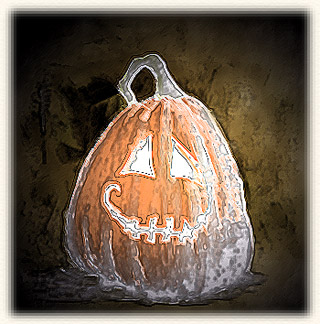
An Irish myth about a man nicknamed "Stingy Jack" is believed to have led to the tradition of carving scary faces into gourds. According to the legend, Jack tricks the Devil into paying for his drink and then traps him in the form of a coin. The Devil eventually takes revenge and Stingy Jack ends up roaming Earth for eternity without a place in heaven or hell. Jack does, however, have a lighted coal, which he places inside a carved turnip, creating the original Jack-o-lantern. [15]
God, Christians and Halloween
The question then becomes whether God's people can symbolically participate in celebrations that not only trivializes the evil side of the spiritual world, but celebrates it. In light of which, some very pertinent some questions that every Christian needs to carefully consider are
1. When a festival is both traditionally and currently associated with the occult and pagan gods, is it possible for us to venture into Satan's territory and not be affected in any way.
2. The Bible says "Whether, then, you eat or drink or whatever you do, do all to the glory of God." (1 Corinthians 10:31 NASB). Is it possible to participate in a pagan festival to 'the glory of God'?
3. When we participate in Halloween are we not helping publicize and promulgate, however indirectly, what is possibly the single most important day in the world of the occult?
4. Is it not true that when we send our children out trick-or-treating we are allowing them to enact either the practice of the ancient Celts who left treats out to appease the spirits who were afoot that night, or the Catholic tradition of 'souling' when food was distributed to all relatives and poor neighbors who offered to pray for the souls in purgatory.
5. By allowing our children to participate in Halloween, are we not risking their eternal future by allowing them to become familiar with the occult. Even if our children are dressed up as angels, they are also bound to come into close contact with other children dressed as vampires, zombies, witches and ghosts They are also going to walk up to houses decorated with symbols associated with death, evil and the occult. Could this exposure not pique their interest in all things evil? Unfortunately, as clearly evinced by the popularity of the Harry Potter books, all too many children are fascinated by the magic, spells, demons, and other things that the Scriptures warn us to stay away from.
6. Are we not dulling our children's ability to distinguish between what is dark and evil and what is light and pure.
7. Ephesians 5:8 says "for you were formerly darkness, but now you are Light in the Lord; walk as children of Light" (NASB). It is okay to walk as children of Light 364 days a year, and walk as a child of Satan the other night? Similarly, is it okay to dwell on "whatever is true, whatever is honorable, whatever is right, whatever is pure, whatever is lovely, whatever is of good repute, if there is any excellence and if anything worthy of praise" (Philippians 4:8) every night but one?
8. How can one possibly be an imitator of God (Ephesians 5:1) when one is imitating the occult?
9. How can God take anything but a very dim view Christian children dressing up as devils, witches, ghosts, and monsters? when His words very specifically tells us to come out from evil and be separate. Can Halloween be considered, at least in some sense, "walking in the darkness"?
What About Christmas and Easter?
D. Quinn
Since both Christmas and Easter have some roots in pagan festivals, Christians have often questioned whether we should partake in celebrations which was not specifically commanded, and which include non Christian customs including feasting and decorating. While there still remains the danger of the wholesale commercialization of Christmas and we should be wholly aware of what "The Easter Bunny/Easter Eggs" are symbolic of; we can also accept that both of these are days on which we honor God's gift of Christ's birth and resurrection.
While both Christmas and Easter have emerged from their pagan roots to become fully and wholly accepted Christian festivals, festivals like Halloween have maintained their ancient traditions. By allowing our children to masquerade as witches and goblins, not only are we giving tacit approval to the mind set that ugly and evil creatures are okay but we are also consenting to our children's and (in many cases) our participation in primeval pagan rituals that celebrate all that is evil. The real issue is not that of comparison between Christmas/Easter and Halloween, it is whether we are willing to participate in a festival that condones communication with the dead, celebrates the rising of evil creatures onto the earth and has us making "peace offerings" to these beings out of fear that they may play tricks on us?
And so in returning to the original question, can we compare the celebration of Christmas or Easter with the blatant satanic celebrations of Halloween? Make no mistake, the differences between them are not merely cosmetic they run much deeper and while Christmas and Easter may have 'borrowed' way too much from pagan neighbors, they are a far cry from Halloween which is (as it always was) a celebration of evil. There is really no comparison.
See Should Christians Celebrate Christmas, Easter, the Jewish Feasts? Also Santa Claus - Pretender To The Throne.
All on THIS Page
Having Fun Vs. Keeping His Commandments
Most Christians who participate in Halloween do so on the premise that it all in "fun" and has no pagan or occult significance for them. In other words, we can take advantage of our Christian liberty because we do not engage in the original practices and do not have the same intent. for those who believe that dressing up as witch or ghoul is only a bit of fun, remember what the Bible says about imitating "detestable things".
When you enter the land which the Lord your God gives you, you shall not learn to imitate the detestable things of those nations. Deuteronomy 18:9 NASB)
Beloved, do not imitate what is evil, but what is good... (3 John 1:11 NASB)
Thus says the Lord, "Do not learn the way of the nations... (Jeremiah 10:2 NASB)T
The New Testament was not far behind
Do not be bound together with unbelievers; for what partnership have righteousness and lawlessness, or what fellowship has light with darkness? Or what harmony has Christ with Belial, or what has a believer in common with an unbeliever? Or what agreement has the temple of God with idols? For we are the temple of the living God; just as God said, "I will dwell in them and walk among them; and I will be their god, and they shall be My people. "therefore, come out from their midst and be separate," says the Lord. "and do not touch what is unclean; And I will welcome you. (2 Corinthians 6:14-17 NASB)
Do not participate in the unfruitful deeds of darkness, but instead even expose them; for it is disgraceful even to speak of the things which are done by them in secret. (Ephesians 5:11-12 NASB)
I have no idea how anyone can imagine that God somehow overlooks or excuses all the evil associated with Halloween as long as their children dress up as Bible characters instead of witches and goblins. Whatever they dress up as, there is no getting away from the fact that our children are not only imitating practices that have their origin in supernatural and magical beliefs, but are doing so on a night that even today has special significance to pagans and occultists.
To be in a right relationship with God means keeping His commandments... There is nothing ambiguous about the connection the New Testament makes between the two...
The Bible says "By this we know that we have come to know Him, if we keep His commandments. The one who says, "I have come to know Him," and does not keep His commandments, is a liar, and the truth is not in him; (1 John 2:3-4 NASB).
Yet Christians blatantly and unapologetically disobey the Lord's very explicit commands not to participate in nor to imitate the evil practices of the pagan nations but to come out from their midst and be separate.
Note: Simply professing Christ as Lord, attending church, reading the latest "Christian" book, attending one of the the never ending "Christian" conferences (whatever those are), or drinking your coffee from a mug marked with a Bible verse, will do nothing for you. To obey is all important, and takes precedence over everything else. If we do not do so, we will hear the same words that Saul did..."The Lord has rejected you".
See Myth of Faith Alone
"Christian" Alternatives?
There are two schools of thought among Christian conservatives. The first is that a Halloween alternative event such as a fall festival can be substituted for the traditional celebration. However, this seems to me to be way too much of a compromise. Albert Dager might take a more stringent path, but he is right when he says (All Emphasis Added)
No matter what the evil, parents are forever searching for alternatives in order that their children not feel deprived of the world's fun. When it comes to Halloween, Christians decide to substitute their own parties for the worlds. Instead of calling their festivities "Halloween parties," they call them "Harvest Festivals" and dress them in biblical costumes.
But that's what Halloween is: a harvest festival.
Besides, many children wear biblical costumes for Halloween anyway, so what's the difference except in the compromise of their minds? You can be sure that to most children it's still Halloween that they're celebrating...
It is a religious spirit that persuades Christians that, by substituting angel costumes for witches' costumes they are somehow pleasing God. His Word calls for separation, not compromise.
It isn't going to traumatize children if they aren't allowed to join in some things just because "everyone else is doing it." It's the responsibility of Christian parents to teach their children the truth from the beginning; not to wait until they have been sufficiently infected by the world that they must be deprogrammed at a later date. Children who are taught to love Jesus will understand that, because of that love, they shouldn't have anything to do with the celebration that glorifies the power of God's enemies. [16]
The Danger to Our Children
In the final analysis, one Christian mother accurately and effectively sums up the immense danger to our children.
Let's say that we do let our kids be involved. We get them a cute Barbie or Bat Man costume, decorate the house up like a graveyard, and buy lots and lots of candy. Harmless right? You hit the road on Halloween and your little one starts to see other children dressed as witches, demons, and other assorted monsters. What do you say? Now think about this - don't answer too fast. You are building a foundation here that will mold how they think about the occult.
If you say, "It's OK honey, it's just for fun." - Your child will remember that it is OK to emulate evil. If you say, "Just ignore them, they don't know any better" - Your child will learn not to care about the lost around them. Any response that you give that tries to smooth over the representation of the occult in Halloween will dull their ability to determine what is dark and evil and what is light and pure.
Let's say that you do choose the popular road of "it's all for fun." Your children accept that and they completely enjoy Halloween all through childhood. Maybe they have even dressed up as a witch once or painted blood on their face, 'all in fun'. Maybe you let them read 'Goosebumps' books and watch a few scary movies too, 'just for kicks'. Then your son comes home from a sleep-over and you discover that they have been playing with a ouija board and some strange stuff happened. How do you respond to that? His attitude is that it has been 'all in fun'. Your son has heard you say all his life that it doesn't hurt anything if you didn't mean it to be serious.
Your child is confronted in school with tarot cards and she accepts a 'reading' from a friend. She is fascinated and starts playing with them herself. She reads about how she needs to be a empty vessel for the spirits to move through. How will she even know that it is a forbidden practice if you have not brought her up to know what the Word has to say about clairvoyants? How do you tell a 15 year old that it is a dangerous when you have allowed her to be involved in an occult holiday year after year? [17]
And if that doesn't give you permanent pause, I don't know what will.
More Food For Thought
The problem with our Halloween is that it's sub-pagan. That is, it doesn't even rise to the level of paganism. That's not a compliment, but a warning about our own triviality. To be more exact, it is a warning about not taking the reality of life, death, and evil seriously enough. I say this whether your child is dressed as a howling, half-putrefied zombie or Taylor Swift.
The origins of Halloween lie with the ancient pagan Celts in the celebration of Samhain (pronounced "sow-in"), a kind of harvest-end festival marking the time when the life-giving summer and fall give way to the harsh and bare deadness of winter, the time of light and warmth to the time of darkness and cold. Given that a fair number of them would not make it through winter or would starve or succumb to sickness in the spring before any crops could spring up - a real danger for many ancient people - they knew they were staring death in the face.
On the night of Samhain, the Celts believed that the heavy veil dividing the world of the living from the dead was mysteriously thinned, and the beloved dead as well as malignant spirits roamed the world. The beloved dead were helped back home by fires and candles lighting the way. The evil spirits were warded off by frightening masks, or, with the Celtic Druid priests, by religious rites including, sometimes, human sacrifice.
We no longer mark our years by natural divisions like the ancient pagans. It is hard for us, to say the least, to conjure up what it really meant to have a harvest festival - a celebration of the food derived from the good earth that was to keep one's family alive against the cold, clutching fingers of dark winter - while we're opening a can of processed pumpkin bought from the store. We know we can just go to the store anytime in January and February, and the shelves will be full. There will even be "fresh" tomatoes in the produce aisle. We are neither especially thankful for food nor especially worried about death. And the reason is the same: unlike the ancient pagans, death has no sting for us.
But that isn't the only reason death has no sting for us. We live in a largely secularized culture, one that has cast away notions of the afterlife, of the soul's peril, of real demons and real evil. There is no veil dividing us from another world, no greater cosmic drama stretching from this life to the next, no realm of supernatural beings devoted either to our eternal bliss or to our eternal torment. Our dead are gone; they are not potential harbingers of hope or warning from beyond; they do not wait to pass through the curtain on All Hallows Eve. Nor are we worried about any demonic beings, entirely bent on causing evil and misery whose only pleasure lies in the destruction of life, goodness, and happiness. Both the exalted good of heaven and the unimaginable misery of hell have been banished to the world of myth.
Secularization has brought us to be quite content with a much smaller, less perilous world, with only one dimension to it - the pleasures we can get from this life. That is, I think, why Taylor Swift or Frozen character costumes are appropriate for our young. It also explains the rage for scantily clad adult women costumes. That's as good as it gets... if the material world is all there is. [18]
Footnote I - What the Bible Says About Pagan 'gods'
The question is whether pagan deities are simply "myths" or made up stories told in ancient cultures to explain a practice, belief, or natural occurrence, and although they were believed by many people, there was no truth to them. On the other hand do the specific characteristics of false gods such as nature, gender and authority stem from the fact they are neither imaginary nor fictitious, but actually exist?
The Biblical condemnation of idolatry, usually defined as worship of any cult image, idea, or object, as opposed to the worship of a monotheistic God, is very strongly worded and found all through Scripture. In fact, it is singled out as the most abominable of sins. A search on the word idol in the Bible turns up well over 100 results, most of which have to do with God's opinion of idols and His warnings as to what will eventually happen to both the idols themselves and those who worship them.
Note: an idol is a representation or symbol of a deity that has been ascribed with divine power and is the object of worship. The word 'worship' comes form an Old English word 'worthship' something that was worthy of being honor or renown. Thus it is the reverent love and devotion accorded a deity, an idol, or a sacred object, and includes any ceremony that formally honors them.
God did not condemn idolatry throughout the Bible for no reason. False gods are clearly associated with the demonic. For example, the word translated "idols" in Psalm 96:5 ("all the gods of the nations are idols" ) is daimonia or "demons" in the Septuagint, which is the ancient Greek translation of the Jewish scriptures. (See The Septuagint). From cover to cover, the Bible does not differentiate between sacrifices made to idols and sacrifices made to demons.
They sacrificed to demons who were not God, To gods whom they have not known, New gods who came lately, Whom your fathers did not dread. "You neglected the Rock who begot you, And forgot the God who gave you birth. (Deuteronomy 32:17-18 NASB)
They [the Israelites] did not destroy the peoples, as the Lord commanded them, but they mingled with the nations and learned their practices, and served their idols, which became a snare to them. They even sacrificed their sons and their daughters to the demons. (Psalms 106:34-37 NASB)
In the New Testament, Paul was very clear that the Gentiles sacrificed to devils.
What do I mean then? That a thing sacrificed to idols is anything, or that an idol is anything? No, but I say that the things which the Gentiles sacrifice, they sacrifice to demons and not to God; and I do not want you to become sharers in demons. You cannot drink the cup of the Lord and the cup of demons; you cannot partake of the table of the Lord and the table of demons. (1 Corinthians 10:19-21 NASB)
In short, from antiquity to modern times those who practice paganism are guilty of worshipping demonic forces - the images or symbols simply providing a point of focus. Deities as Zeus, Amun-Ra, Demeter, Isis and Apollo are real personalities; Osiris was a genuine underworld fiend; Hecate actually lived, and still does! The Hindu gods Shiva and the eight-armed Kali are far more than man made images.
Similarly, the Celtic gods and goddesses including the Horned God and The Crone are simply classic names given genuine spirits that are very much alive.. {PLACE IN TEXT}
End Notes
[01] Cost of Halloween in The United States. https://www.pricegun.com/cost-of-halloween-in-the-united-states/
[02] Selena Fox. Celebrating Samhain. https://www.circlesanctuary.org/index.php/celebrating-the-seasons/celebrating-samhain
[03] MacBain's Dictionary - Section 32. http://www.ceantar.org/Dicts/MB2/mb32.html#samhuil
[04] Edain McCoy. Sabbats: A Witch's Approach to Living the Old Ways (Llewellyn's World Religion and Magick) Pg.. 23. Llewellyn Publications; 1st edition (September 8, 2002
[05] German Culture. Allerheiligentag (All Saints’ Day) in Germany.
https://germanculture.com.ua/german-holidays/all-pumpkins-night-in-germany/
[06] Samhain. History.Com Editors https://www.history.com/topics/holidays/samhain
[07] Samhain ancient Celtic festival. https://www.britannica.com/topic/Samhain
[08] Clan Campbell Society. Samhain, Halloween, and the Day of the Dead.
https://www.ccsna.org/samhain-halloween-and-the-day-of-the-dead
[09] Lesley Bannatyne. Halloween: An American Holiday, An American History, Publisher: Pelican Publishing; 1st Pelican ed edition (August 31, 1998) Pgs. 9, 11
[10] How Did a Pagan Holiday Become a 'Christian' Celebration? Beyond Today.
https://www.ucg.org/the-good-news/how-did-a-pagan-holiday-become-a-christian-celebration
[11] Jack Santino. Halloween. The Fantasy and Folklore of All Hallows. http://www.loc.gov/folklife/halloween.html
[12] Selena Fox. Celebrating Samhain. https://www.circlesanctuary.org/index.php/celebrating-the-seasons/celebrating-samhain
[13] Today's Halloween Traditions. http://www.history.com/topics/halloween/history-of-halloween]
[14] Nicholas Rogers Halloween: From Pagan Ritual to Party Night.. Publisher: Oxford University Press (October 31, 2003). Pages 28,29.
[15] Halloween Tales & Traditions. History.Com Editors. Jack-o-Lanterns and the Legend of 'Stingy Jack'. https://www.history.com/news/halloween-facts-traditions-legends
[16] Albert James Dager. Halloween. Should Christians Be Apart? http://www.mediaspotlight.org/pdfs/HALLOWEEN.pdf
[17] Kelly McCausey Why We Don't Celebrate Halloween.
http://www.christian-mommies.com/special-features/bible-studies/why-we-dont-celebrate-halloween/
[18] Dr. Benjamin Wiker. The Ghost Of Halloween... What Ancient Pagans Knew That Moderns Risk Forgetting.
http://tothesource.org/10_23_2015/10_23_2015.htm
|